Risks of Investing in Unlisted Shares in India
Published: 28 min read
Unlisted shares can give investors access to companies before an IPO and to businesses that may remain privately held for years. But unlike listed shares, they can involve different risks around liquidity, valuation, information availability, transferability and transaction settlement.
That does not mean every unlisted share is unsafe. In fact, the risk can vary considerably from one security to another.
A frequently traded unlisted share with an established transaction process can present very different practical risks from a newly introduced or rarely traded security available only in larger lots.
The more useful question, therefore, is not simply “Are unlisted shares safe?” It is:
What risks am I taking, which of those risks can I reduce, and what should I check before investing?
This guide explains the major risks of investing in unlisted shares in India, using practical examples and transaction-level considerations to help investors make a more informed decision.
Quick Answer: What Are the Main Risks of Unlisted Shares?
The major risks include:
- Liquidity risk — you may not be able to sell when you want.
- Valuation risk — the price you pay may not reflect the underlying value of the company.
- Counterparty and settlement risk — the seller, documentation or settlement process may create problems.
- ISIN and depository risk — certain securities can have specific NSDL/CDSL or transfer-related considerations.
- Transferability risk — ROFR or other restrictions may affect your ability to transfer the shares.
- IPO risk — an expected IPO can be delayed, repriced or may never happen.
- Disclosure risk — information available for an unlisted company may be more limited than for a listed company.
- Fundamental risk — the company itself can underperform.
- Dilution risk — future fundraising or conversion of securities can affect ownership.
- Tax risk — taxation can reduce the return you ultimately retain.
- Concentration risk — larger minimum ticket sizes can result in excessive exposure to one company.
Some of these risks are inherent to unlisted investing, while others can often be identified and reduced through proper due diligence.
Are Unlisted Shares Risky?
Yes, unlisted shares carry investment and transaction risks, but that does not make every unlisted investment inherently unsafe.
The risk profile is simply different from that of listed shares.
It helps to divide the risks into three categories.
Investment risk
This is the risk that the company or investment thesis does not perform as expected.
It includes:
- high valuation
- weak financial performance
- business-model risk
- dilution
- governance concerns
- IPO expectations not materialising
Market and liquidity risk
This relates to your ability to find a buyer and determine a reasonable market price.
It includes:
- limited buyers
- infrequent transactions
- uncertain exit timelines
- less transparent price discovery
Transaction and settlement risk
This relates to whether the actual purchase and transfer of the shares can be completed properly.
It can involve:
- ISIN issues
- depository arrangements
- transfer restrictions
- ROFR
- seller reliability
- documentation
- settlement timelines
This distinction matters because a transaction can be completed perfectly and the investment can still lose value.
Similarly, a fundamentally attractive company can still create unnecessary problems if the security and transaction mechanics are not properly checked.
1. Liquidity Risk in Unlisted Shares
Liquidity risk is one of the most important risks of investing in unlisted equities.
When you own a listed share, you can generally place an order on the exchange and access a large pool of potential buyers and sellers.
An unlisted share does not necessarily have that same continuous exchange-based market.
That means owning an unlisted share does not guarantee that you can sell it whenever you want.
Can I sell unlisted shares anytime?
Not necessarily.
Your ability to sell can depend on:
- availability of buyers
- demand for that particular company
- transaction size
- prevailing market conditions
- transferability
- company or shareholder restrictions
- trading frequency
If you may need the money within a short period, this risk becomes particularly important.
If you want to understand the actual exit process in more detail, see our guide on how to sell unlisted shares in India.
Frequently traded vs rarely traded unlisted shares
Not all unlisted shares have the same liquidity.
Some securities have regular transactions and multiple market participants. There may be more observable prices and a relatively established transaction process.
Others may be rarely traded, newly introduced or available only in larger lots.
These securities can involve:
- fewer buyers
- limited transaction history
- less reliable price discovery
- larger lot requirements
- additional transfer or settlement considerations
What we see in practice
From our experience handling unlisted-share transactions, the distinction between frequently traded and rarely traded securities matters.
For securities that trade regularly, there are generally fewer unknowns around the basic transaction process.
For a newly introduced or rarely traded security, however, we may need to conduct additional checks around the ISIN, depository, transferability and other transaction mechanics before proceeding.
That is a practical risk that may not be obvious from simply looking at the quoted share price.
How can investors reduce liquidity risk?
Before investing, ask:
“How long can I comfortably keep this money invested if I cannot find a buyer?”
You should be comfortable with the possibility that your exit may take longer than expected.
2. Price Discovery and Valuation Risk
Another important risk is paying too much for an unlisted share.
A listed share has continuous buying and selling activity that provides a visible market price.
For an unlisted share, there may be fewer transactions and fewer participants. As a result, the quoted price may not necessarily represent the company's fair or intrinsic value.
A quoted price is not necessarily fair value
It is useful to distinguish between:
- quoted price
- recent transaction price
- seller's asking price
- estimated fundamental value
These are not necessarily the same.
A seller may quote a price based on demand or expectations. A recent transaction may have occurred under different market conditions.
Therefore, investors should not assume that a price being available means that the price is automatically fair.
Why can pre-IPO shares become expensive?
This is particularly important when a company is approaching an expected IPO.
As the IPO gets closer, investor interest can increase. Sellers may also price the shares based on expectations around the eventual listing valuation.
This can create a situation where investors buy because they expect a large listing gain rather than because the current price is attractive relative to the company's fundamentals.
A practical lesson for first-time investors
One of the risks we see in the market is investors approaching a pre-IPO investment primarily with the expectation:
“The company is going to list, so I should buy before the IPO.”
But the IPO itself does not determine whether today's purchase price is attractive.
Just as with listed shares, investors should consider value, fundamentals and future prospects, rather than simply buying because demand is currently high.
What should investors evaluate?
Depending on the information available, investors can consider:
- revenue growth
- profitability
- cash flow
- debt
- business prospects
- future plans
- comparable companies
- valuation multiples
- capital structure
- potential dilution
- recent transaction prices
Unlisted Valley can provide the transaction price at which shares are being offered, but whether that price represents attractive value is ultimately something the investor should independently evaluate.
The goal should be to understand what you are paying relative to the business—not simply what you expect someone else to pay for it later.
For a deeper explanation of how unlisted companies can be valued, see our guide to unlisted share valuation methods.
3. Counterparty and Settlement Risk
Unlisted investing involves another layer that listed-market investors may encounter less often: the transaction itself has to be properly executed between parties.
A seller can agree to sell shares and later reconsider the transaction, particularly if there is a major sudden movement in the market price.
This is one reason transaction structure and settlement discipline matter.
What can go wrong?
Potential issues include:
- seller backing out
- incomplete documentation
- incorrect shareholder details
- inability to deliver the securities
- misunderstanding over settlement timelines
- payment and delivery not occurring as expected
The risk can become more important for large or block transactions, where the transaction may be privately negotiated. If you are unfamiliar with how a typical private-market purchase works, our guide to how to purchase pre-IPO shares in India explains the process step by step.
Same-day delivery and larger transactions
For straightforward transactions, prompt payment and delivery can reduce the period during which either party remains exposed to changing market conditions.
For larger transactions, a sale-purchase agreement or appropriate transaction documentation can establish the obligations of both parties more clearly.
The documentation should reflect the size and complexity of the transaction.
What about escrow?
An escrow arrangement can help manage certain payment and settlement risks by controlling when funds are released.
However, escrow does not eliminate:
- valuation risk
- company-specific risk
- liquidity risk
- IPO risk
- poor business performance
In simple terms:
Escrow can reduce certain transaction risks. It does not make the underlying investment risk-free.
4. ISIN and Depository Risk
One area that first-time investors may not think about is the practical mechanics of transferring the security.
An ISIN (International Securities Identification Number) identifies a particular security.
Before purchasing, investors should verify that the ISIN corresponds to the intended security and understand its current status and applicable transfer mechanism.
Depositories such as NSDL and CDSL play an important role in holding securities in dematerialised form.
Why can ISIN and depository issues create problems?
For frequently traded securities, the transaction mechanics are usually familiar to the participants involved.
For newly introduced or rarely traded securities, however, practical issues can arise.
For example, a security may be available through one depository arrangement but not the other for the intended transaction.
If this is discovered only when the shares are supposed to be delivered, it can cause unnecessary delays.
A real-world example: PXIL
PXIL (Power Exchange India Limited) is a useful example of why investors should understand the depository and transfer mechanics of an unlisted security before purchasing it. For securities that are less frequently traded, investors should verify the applicable ISIN, depository, transferability and demat requirements before proceeding with a transaction.
Where a security is currently available for trading or transfer through a particular depository arrangement, investors should know this before initiating the transaction rather than discovering the limitation at settlement.
The key lesson is not that a particular depository arrangement makes an investment good or bad.
It is:
Know how the security can actually be transferred before you commit your money.
What should investors check?
Before buying an unlisted security, verify:
- ISIN
- security name
- face value
- security type
- ISIN status
- applicable depository
- transferability
- whether the security is freely transferable
- whether the intended demat account can receive the security
These checks are particularly important when the security is new to the market or rarely traded.
5. Transfer Restrictions and ROFR Risk
Another risk that investors should understand is that not every unlisted share is necessarily freely transferable.
Depending on the company's structure and governing documents, a transfer may be subject to certain conditions.
These can arise from:
- Articles of Association
- shareholder agreements
- company policies
- contractual arrangements
- ROFR (Right of First Refusal)
What is ROFR?
A Right of First Refusal generally gives an existing shareholder or another specified party the opportunity to purchase shares before they are sold to an outside buyer, depending on the applicable terms.
This can be particularly relevant for rarely traded shares, closely held companies and certain block or private transactions.
What should investors ask?
Before purchasing, ask:
- Are the shares freely transferable?
- Does the company need to approve the transfer?
- Is there an ROFR?
- Are there other shareholder-level restrictions?
- Are there specific documents required for transfer?
A basic transferability check can prevent a significant problem later.
6. IPO and Listing Risk
For many investors, the biggest attraction of a pre-IPO share is the possibility of an eventual listing.
That possibility can also create one of the biggest misconceptions around pre-IPO investing.
An IPO is not a guaranteed exit
An IPO can be:
- delayed
- repriced
- postponed
- affected by market conditions
- affected by regulatory or legal developments
- changed because of investor demand
- affected by the company's own strategy
Therefore, an investor should not treat an expected IPO date as a guaranteed exit date.
What happens if a company never gets listed?
An unlisted share does not automatically become worthless simply because an IPO does not happen.
The company still has a business, assets, liabilities, shareholders and potentially significant economic value.
However, without a public market:
- liquidity may remain limited
- valuation may be harder to establish
- finding a buyer may take longer
- other private-market exit routes may become more important
Those routes could include secondary transactions, buybacks, acquisitions or other corporate events, depending on the company.
The important point is:
Buy the business you are comfortable owning, not just the IPO you hope will happen.
Real-World Example: Zepto and IPO Valuation Risk
Zepto provides a useful example of why investors should not treat an expected IPO valuation as a certainty.
In 2026, reports indicated that institutional investors were pushing for a lower valuation than the company had previously commanded in private markets. Reports subsequently indicated changes to Zepto's IPO plans and timing.
The important lesson isn't that Zepto is a bad company or that its IPO will never happen.
The lesson is that a private-market valuation and a public-market valuation are not necessarily the same.
Investor demand, market conditions and the price public-market investors are willing to pay can materially affect an IPO.
For someone buying pre-IPO shares, that means the expected listing price should never be treated as guaranteed.
Real-World Example: NSE and Listing Uncertainty
The National Stock Exchange is another useful example of why investors should avoid assuming that a potential IPO will proceed smoothly or according to an expected timetable.
NSE's listing plans have faced a long and complex path involving regulatory matters and other considerations.
The broader lesson for an investor is not that an IPO will fail.
It is:
A potential listing should be viewed as one possible future event, not as a guaranteed exit strategy.
Investors should therefore evaluate the underlying company and investment independently of the IPO timeline.
7. Regulatory and Disclosure Risk
A common search query is:
Are unlisted shares regulated by SEBI?
The answer is more nuanced than simply saying “yes” or “no.”
The applicable regulatory framework can depend on the company, security, transaction, intermediary and the specific laws and regulations involved. It would be incorrect to simply say that unlisted shares are completely unregulated.
At the same time, investors should not assume that an unlisted company provides the same information environment as a listed company.
Why can information be more limited?
Listed companies operate within extensive public disclosure requirements.
A private or unlisted company may have less publicly available information depending on its structure and applicable requirements.
This can make it harder to independently determine:
- exact outstanding shares
- capital structure
- financial position
- shareholder arrangements
- future fundraising
- corporate actions
Why does this matter for valuation?
Suppose an investor is trying to calculate a company's value per share.
If the number of outstanding shares being used in the calculation is incomplete or incorrect, the resulting per-share valuation can also be wrong.
This is one reason company-level due diligence is just as important as looking at the quoted market price.
What we see in practice
In some private companies, certain fundamental information may not be as readily available as investors would expect from a listed company.
That doesn't automatically mean there is a problem with the company.
It does mean the investor should understand what information is available, what is not available and how much confidence they can reasonably place in any valuation calculation.
What SEBI regulation does not guarantee
Regulatory oversight does not guarantee:
- investment returns
- an IPO
- liquidity
- fair valuation
- company performance
Regulation and investment quality are separate questions.
8. Company-Specific and Fundamental Risk
Ultimately, an unlisted share represents an investment in a business.
If the business performs poorly, the investment can lose value regardless of how smoothly the transaction was completed.
What should investors evaluate?
Depending on the information available, investors can look at:
- revenue growth
- profitability
- cash flows
- debt
- margins
- competitive position
- business model
- management
- governance
- auditor
- litigation
- contingent liabilities
- future funding requirements
Limited analyst coverage
Many private companies do not receive the same level of independent analyst coverage as listed companies.
That means investors may need to do more of their own research rather than relying on a large body of public market commentary.
Cap table and dilution risk
Future fundraising can result in additional shares being issued.
ESOPs, convertible securities, warrants or other instruments can also affect the ownership structure.
Therefore, investors should understand not only how many shares they are buying, but what those shares could represent after future issuances or conversions.
9. Convertible Security and CCP Risk
Some investors encounter securities that are not ordinary equity shares but can eventually be converted into equity.
These securities require additional diligence.
Why does conversion matter?
If you are buying a convertible security, the purchase price alone doesn't tell you everything.
You also need to understand:
How many equity shares will I receive after conversion?
The conversion ratio and applicable terms can materially affect the economics of the transaction.
What should investors check?
Where applicable, verify:
- conversion terms
- conversion ratio
- face value
- corporate resolutions
- official company circulars
- expected number of equity shares after conversion
- conditions attached to conversion
A practical transaction lesson
When dealing with convertible securities, we recommend verifying the conversion mechanics against an official company circular or other appropriate company documentation, rather than relying only on a market quote or informal explanation.
The security itself needs to be understood before the transaction is executed.
10. Tax Risk When Investing in Unlisted Shares
Tax can materially affect your actual return.
The gain you calculate before tax may not be the amount you ultimately retain.
The applicable treatment can depend on factors including:
- holding period
- nature of the transaction
- acquisition cost
- investor status
- applicable tax rules
- whether the investor is a resident or NRI
Tax rules can also change, so investors should verify the rules applicable to their specific circumstances.
This article only covers tax risk at a high level. For detailed information on capital gains, holding periods and other taxation considerations, see our guide to taxation of unlisted shares in India.
11. Minimum Investment and Concentration Risk
Some unlisted shares may only be available in larger lots or may require a relatively large transaction size.
This can happen because of:
- limited supply
- seller requirements
- block transactions
- private transaction structures
- limited secondary-market activity
The bigger concern, however, is not simply that the minimum investment is high.
It is how much of your overall portfolio that investment represents.
A ₹10 lakh investment can have a very different risk for someone with a ₹20 lakh portfolio compared with someone with a ₹2 crore portfolio.
A large minimum ticket can therefore create concentration risk, particularly for first-time investors.
Real Risks vs Perceived Risks in Unlisted Shares
Unlisted shares often attract assumptions that are either too negative or too positive.
Understanding the difference can help investors make better decisions.
Perceived risk: “Unlisted means unsafe.”
Reality: Being unlisted does not automatically mean a company or transaction is unsafe. The actual risks need to be evaluated individually.
Perceived risk: “If there is no IPO, the shares become worthless.”
Reality: The company can continue to have business and economic value even if it doesn't list. However, the lack of a public market can make liquidity and valuation more difficult.
Perceived risk: “The quoted price must be the fair price.”
Reality: A quoted price reflects what a seller or market participant is asking or transacting at. It does not automatically establish intrinsic value.
Perceived risk: “SEBI regulation means my investment is protected.”
Reality: Regulation does not guarantee returns, an IPO, liquidity or company performance.
Perceived risk: “Every unlisted share has the same liquidity.”
Reality: Frequently traded securities can have a very different liquidity and transaction profile from newly introduced or rarely traded securities.
The goal is not to remove every risk.
It is to understand which risks are real, which can be reduced and which you are consciously accepting.
Common Mistakes First-Time Unlisted Share Investors Make
First-time investors often focus heavily on the potential upside and not enough on the mechanics of the investment.
Here are some of the most common mistakes to avoid.
1. Buying solely because an IPO is expected
An IPO can be delayed, repriced or may not happen.
The company should make sense as an investment independently of the expected listing.
2. Assuming the quoted price is fair
A market quote tells you what the security is being offered or traded at.
It does not tell you whether the price is attractive.
3. Ignoring liquidity
A paper gain isn't particularly useful if you cannot find a buyer when you need to exit.
4. Assuming all unlisted shares work the same way
A frequently traded security and a rarely traded security can have very different transaction mechanics.
5. Not checking the ISIN and transferability
This can create avoidable settlement problems.
6. Sending money without understanding the transaction
Investors should know who they are dealing with, how delivery will occur and what happens if the transaction does not settle as expected.
7. Putting too much capital into one company
A large minimum ticket can create excessive concentration.
8. Looking only at the company and ignoring the security
For convertible securities, different share classes or securities with transfer restrictions, understanding the exact instrument matters just as much as understanding the company.
Additional Risks for NRI Investors
For NRIs, the risks of the underlying investment remain the same, but there can be additional regulatory, account, repatriation and tax considerations.
Depending on the transaction, an NRI may need to consider:
- FEMA requirements
- permitted investment routes
- applicable NRO/NRE account considerations
- repatriation rules
- taxation
- documentation requirements
An NRI should therefore not assume that the process is identical to that of a resident Indian.
Because FEMA and tax rules can be situation-specific and change over time, NRIs should verify the requirements applicable to their particular circumstances before transacting.
Risks for Existing Unlisted Shareholders and ESOP Holders
The risk doesn't disappear once you already own the shares.
Existing shareholders and ESOP holders can face different questions around liquidity, transferability, taxation and future dilution.
For example:
- Can the shares currently be transferred?
- Is there an ROFR?
- When can the shares actually be sold?
- What happens if the IPO is delayed?
- Could future fundraising dilute ownership?
- What tax will apply when the shares are sold?
- Is the current paper value realistically achievable in a secondary transaction?
For ESOP holders in particular, the value shown on paper should not automatically be treated as the amount that can be realised today.
The practical exit route and applicable restrictions matter.
Which Unlisted Share Risks Can You Reduce?
Not every risk can be eliminated.
Some can be identified and managed before investing, while others are inherent to investing in a private company.
Risk | Can it be reduced? | Can it be eliminated? |
ISIN/depository risk | Yes, through verification | Often manageable |
Transfer restrictions | Yes, through due diligence | Depends on the restriction |
Counterparty risk | Yes, through verification and documentation | No |
Valuation risk | Yes, through independent analysis | No |
Liquidity risk | Yes, through position sizing and planning | No |
Tax risk | Through proper planning and advice | Not completely |
IPO risk | Only to a limited extent | No |
Fundamental risk | Through research and due diligence | No |
Dilution risk | Through understanding the capital structure | No |
This is an important distinction.
Due diligence is not designed to make an unlisted investment risk-free.
It is designed to identify avoidable problems and help you understand the risks that remain.
Unlisted Shares vs Listed Shares: Which Is Riskier?
The better question isn't simply which one is “safer.”
They have different characteristics.
Factor | Listed Shares | Unlisted Shares |
Liquidity | Generally higher | Can be limited |
Price discovery | Continuous market pricing | Less transparent |
Trading frequency | Usually high | Can vary significantly |
Public information | Generally extensive | May be more limited |
Analyst coverage | Usually higher | Often limited |
Exit | Generally exchange-based | Depends on buyers and transactions |
Valuation visibility | Generally higher | Can be lower |
Settlement complexity | Generally simpler | Can require additional checks |
Transfer restrictions | Generally less prominent | Can be relevant |
IPO dependency | Not applicable | Relevant for many pre-IPO investments |
So, are unlisted shares necessarily riskier?
Not in every respect.
They have a different risk profile.
A listed company can still be a very high-risk investment because of its valuation, business model or volatility.
An unlisted company can have strong fundamentals while carrying greater liquidity and transaction risks.
The important thing is understanding the specific risks attached to the investment.
How to Reduce the Risks of Investing in Unlisted Shares
A simple way to approach due diligence is:
Risk → What can happen → What should you check → How can you reduce it?
Risk | What can happen | What to check | How to reduce it |
Liquidity | You cannot find a buyer | Trading activity and exit options | Invest only capital you can hold |
Counterparty | Seller doesn't complete transaction | Seller and transaction terms | Verify counterparty and documentation |
ISIN | Settlement gets delayed | ISIN, status and depository | Check before transferring funds |
Transferability | Shares cannot be transferred as expected | ROFR and company documents | Confirm transferability beforehand |
IPO | Listing is delayed | Actual company disclosures | Don't rely solely on the IPO |
Fundamentals | Company underperforms | Financials and business | Conduct company-level research |
Dilution | Ownership changes | Cap table and future issuance | Understand capital structure |
Tax | Net return is lower | Applicable tax rules | Evaluate tax before calculating returns |
Concentration | Too much capital is exposed to one company | Portfolio allocation | Size the position appropriately |
Valuation | You overpay | Fundamentals and valuation | Independently assess value |
What Should You Check Before Buying Unlisted Shares?
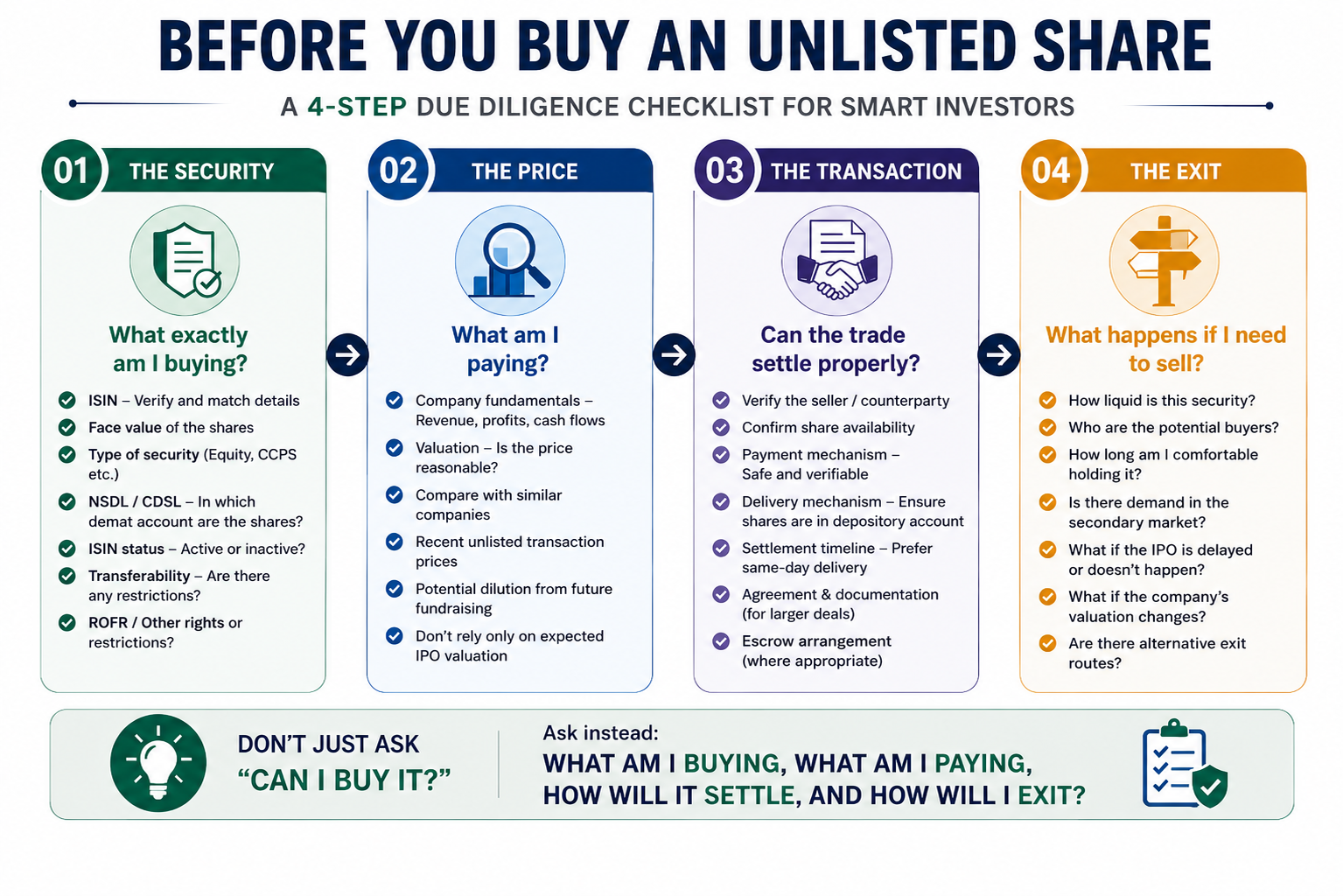
Before committing money, think about four areas:
1. Check the security
- ISIN
- security name
- face value
- security type
- ISIN status
- applicable depository
- transferability
- whether the security is freely transferable
2. Check the company
- latest available financial information
- capital structure
- outstanding shares, where available
- potential dilution
- corporate actions
- shareholder arrangements
- transfer restrictions
- relevant company disclosures
3. Check the transaction
- Who is selling the shares?
- Does the seller actually hold the securities?
- How will payment and delivery occur?
- What are the settlement timelines?
- Is additional documentation appropriate?
- Are there known issues that could delay transfer?
4. Check the investment itself
- How long can you hold the investment?
- What happens if the IPO is delayed?
- What happens if the IPO never happens?
- Is the investment too large relative to your portfolio?
- Have you independently evaluated the company's fundamentals?
- Are you comfortable with the price you are paying?
Who Should Not Invest in Unlisted Shares?
Unlisted shares may not be suitable for everyone.
You should be particularly cautious if you:
- need guaranteed liquidity
- may need the money in the short term
- cannot tolerate uncertain exit timelines
- are investing solely because you expect an IPO
- are uncomfortable with limited price discovery
- cannot tolerate company-specific risk
- would have excessive concentration in one company
- expect the same level of transparency as listed shares
There is nothing wrong with deciding that an unlisted investment is not suitable for you.
In fact, knowing when not to invest is an important part of investing.
What We Have Learned From Handling Unlisted Share Transactions
Reading about unlisted shares and actually handling transactions are two different things.
Some risks only become obvious when you deal with the security at the transaction level.
At Unlisted Valley, we conduct due diligence before executing transactions, with additional checks for newly introduced, rarely traded or structurally more complex securities.
Here are some of the practical issues we have encountered.
ISIN and depository issues
We have encountered situations where an ISIN's depository arrangement created a potential settlement delay.
This is why investors should understand whether a security can actually be received and transferred through the relevant demat setup before the transaction is initiated.
Transfer restrictions
For some rarely traded securities and private transactions, ROFR or other transfer-related provisions can be relevant.
These are the types of issues that should be identified before money changes hands.
Convertible securities
When dealing with convertible securities, the conversion ratio and resulting equity entitlement need to be checked carefully.
Where applicable, we look for an official company circular or appropriate company documentation confirming the conversion mechanics rather than relying only on an informal explanation.
Seller reliability
We have also seen situations where a seller can reconsider a transaction following a significant sudden movement in the market price.
This is one reason why reliable counterparties, clear settlement terms and appropriate documentation become more important for larger transactions.
IPO uncertainty
The path to an IPO is not always straightforward.
Companies can face valuation challenges, market conditions, regulatory matters or other hurdles that change the expected timing or economics of a listing.
These experiences have shaped a simple principle in how we approach transactions:
Material transaction-related risks should be disclosed rather than hidden simply to complete a trade.
Where an issue can be resolved, the transaction can be evaluated accordingly. Where a material issue remains, the decision should depend on the circumstances and the client's informed understanding of that risk.
At the same time, valuation and investment suitability require independent judgment.
Our role in a transaction is not to tell an investor that a particular price automatically represents a good investment. Investors should independently assess the company, valuation, time horizon and their own risk tolerance.
Frequently Asked Questions About Risks of Unlisted Shares
Can I sell unlisted shares anytime?
No. Unlisted shares do not necessarily have a continuous exchange-based market. Your ability to sell depends on buyers, demand, transferability, transaction size and other factors.
Is investing in unlisted shares safe?
Unlisted shares are not risk-free. They carry liquidity, valuation, company, transaction and other risks. The important question is whether you understand and are comfortable with the specific risks involved.
Are unlisted shares riskier than listed shares?
Not necessarily in every respect. Unlisted shares generally have a different risk profile, with potentially lower liquidity, less transparent price discovery and greater transaction complexity.
How can I check if an unlisted share price is fair?
Consider the company's fundamentals, financial performance, comparable businesses, valuation multiples, capital structure, potential dilution and recent transaction information where available. A quoted price alone does not establish fair value.
What happens if a company never gets listed?
The shares do not automatically become worthless. However, the absence of an IPO can make liquidity and price discovery more difficult, while the investor may need to rely on other private-market exit opportunities.
Are unlisted shares regulated by SEBI?
The answer depends on the company, security, transaction and applicable regulatory framework. It is inaccurate to describe all unlisted shares simply as “unregulated.”
What is liquidity risk in unlisted shares?
Liquidity risk is the possibility that you may not be able to sell your shares when you want to, or may have to wait for a suitable buyer.
What should I check before buying unlisted shares?
At a minimum, understand the ISIN, face value, security type, depository, transferability, transaction process, company fundamentals, potential dilution, liquidity and possible exit routes.
Can unlisted shares have transfer restrictions?
Yes. Depending on the company and applicable documents, there may be ROFR or other contractual or company-level restrictions.
What is ROFR in unlisted shares?
ROFR stands for Right of First Refusal. Depending on the applicable terms, it can give an existing shareholder or another specified party the opportunity to purchase shares before they are transferred to another buyer.
What are the risks of buying unlisted shares from a seller?
Potential risks include seller reliability, documentation problems, inability to deliver securities, transfer restrictions and settlement delays.
What is the minimum investment in unlisted shares in India?
There is no single minimum applicable to every unlisted share. The amount can vary based on the security, available lot size, seller and transaction structure.
Are unlisted shares safe for NRIs?
NRIs need to consider additional FEMA, account, repatriation and tax requirements, depending on the investment and transaction. They should verify the requirements applicable to their circumstances before investing.
What are the tax risks of unlisted shares in India?
Tax treatment can affect your final return and may depend on factors such as holding period, investor status and the nature of the transaction.
What risks should first-time investors consider?
First-time investors should pay particular attention to valuation, liquidity, IPO assumptions, transferability, settlement, company fundamentals and concentration risk.
Final Takeaway: Understand the Risk Before You Invest
The biggest mistake an investor can make with unlisted shares is not necessarily taking risk.
It is taking a risk without knowing that they are taking it.
Before buying, ask four simple questions:
1. What exactly am I buying?
Verify the security, ISIN, face value, depository, transferability and any special terms.
2. What am I paying for it?
Don't assume that a quoted or popular pre-IPO price represents fair value. Evaluate the company and valuation independently.
3. How will the transaction happen?
Understand the seller, documentation, payment, delivery and settlement process.
4. What happens if my expected exit does not happen?
If the IPO is delayed, valuation changes or there is no immediate buyer, know whether you are comfortable continuing to hold the investment.
Unlisted stocks can provide access to businesses that investors cannot access through the public market today.
But that opportunity comes with a different set of risks.
The objective of due diligence isn't to make those risks disappear.
It is to understand which risks you are taking, which ones you can reduce and whether you are comfortable with the risks that remain.
Understand your risk profile before you transact.