How to Buy NSE Unlisted Shares in India | Step-by-Step Guide
Published: Updated: 19 min read
Buying NSE unlisted shares in India is different from buying a stock such as Reliance, HDFC Bank or TCS through a regular stock exchange. Since the shares of National Stock Exchange of India Limited are themselves unlisted, there is no live exchange order book through which investors can simply place a buy order.
Instead, NSE shares are traded through a private-market transaction. An investor first confirms the available quantity and price, completes the required KYC, makes the payment and receives the shares through an off-market transfer into their demat account.
This is the broad process used across the unlisted market for equity shares of companies that have not yet gone public, although the exact procedure can vary between intermediaries.
The process itself is relatively straightforward. The more important questions are what you are buying, the price you are paying, how the purchase is completed and how you may eventually exit.
This guide explains how to buy NSE unlisted shares, what you need before making a purchase, what happens after payment and the key checks a first-time investor should make.
Quick answer: To buy NSE unlisted shares, you generally need to find an available seller or platform, confirm the price and quantity, complete KYC and demat verification, review the transaction details or deal note, make the payment and receive the shares through an off-market transfer into your demat account.
Can You Buy NSE Unlisted Shares in India?
Yes. NSE shares can be bought and held by investors even though NSE itself is not currently a listed company.
The important distinction is between listed shares and unlisted shares.
When you buy a listed stock, your order is matched through an exchange's trading system. You can normally see market prices, bids and offers and execute the trade through your broker on a public stock exchange such as the NSE or BSE.
With an unlisted share, there is no equivalent continuously traded exchange order book. The purchase instead takes place in the private market between a buyer and seller, either directly or with the assistance of an intermediary.
This means the process to buy NSE unlisted shares involves a few additional steps, particularly around price confirmation, availability, payment and share transfer.
For a first-time buyer, this may sound complicated, but the process becomes much easier once you understand how unlisted shares work and what each stage involves.
If you're new to unlisted shares, you can also read our beginner's guide to unlisted shares before going through the purchase process.
How to Buy NSE Unlisted Shares: Step-by-Step
The exact process can differ between intermediaries, but a typical NSE unlisted share buying process follows these stages.
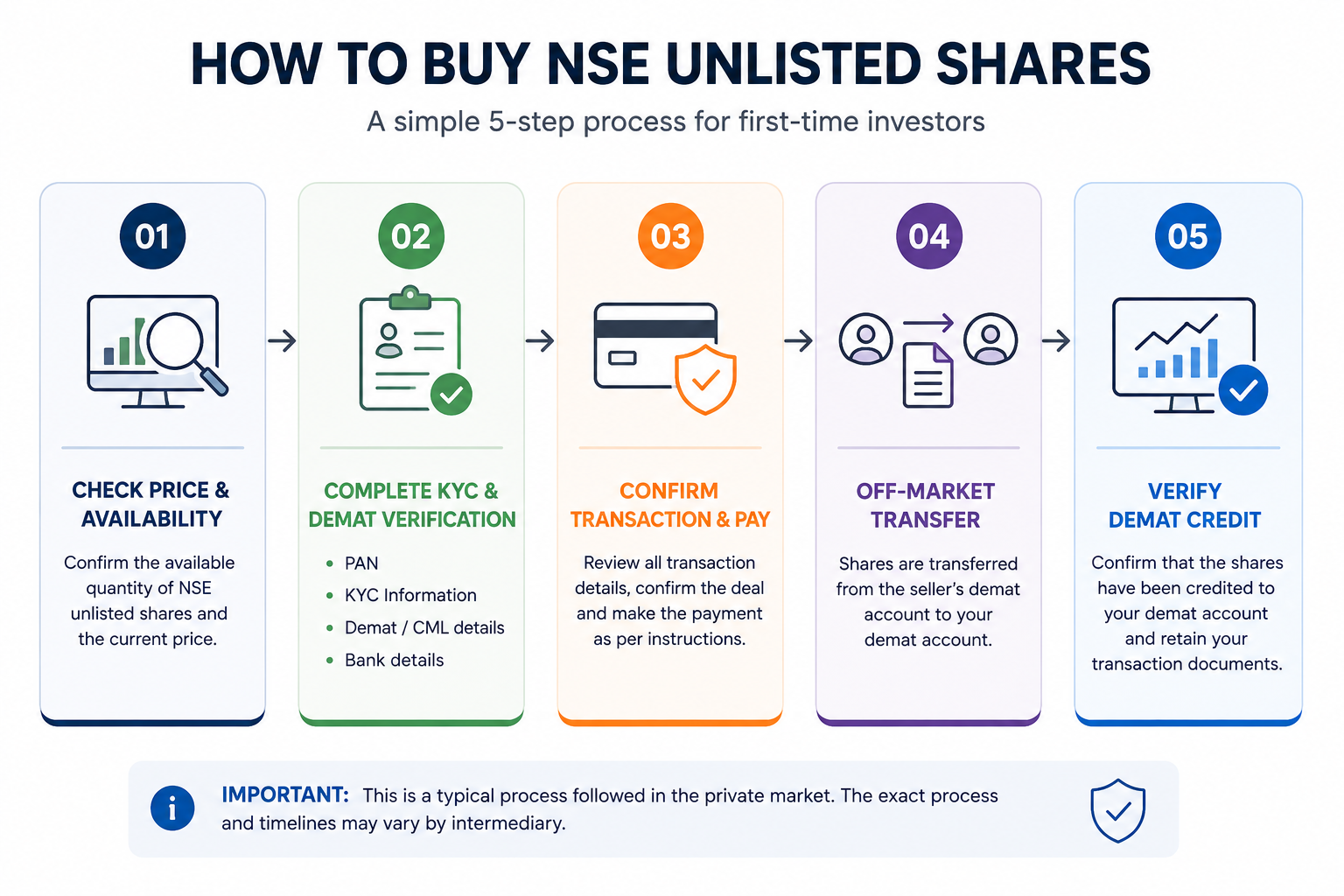
Step 1: Check the Current NSE Unlisted Share Price and Availability
The first step is to find out whether the required quantity of NSE unlisted shares is available and at what price.
Unlike listed stocks, there is no single live exchange price at which every buyer and seller must transact. Private-market prices can change based on supply and demand, availability, transaction size and market conditions.
If you already have a target price, you can communicate it to the intermediary and negotiate from there. Depending on market availability, the purchase may or may not be possible at that price.
Always confirm the share price immediately before proceeding. It can also be useful to compare multiple quotes, provided you are comparing the same security, quantity and transaction terms.
You can check the latest NSE unlisted share price before deciding whether to proceed.
Step 2: Decide How Many Shares You Want to Buy
Once the price and availability are known, confirm the number of shares you want to purchase.
Your basic transaction value is:
Number of shares × price per share = amount payable
For example, if you want 100 shares at an illustrative price of ₹2,000 per share, the share consideration would be ₹2,00,000.
The actual available quantity and price should always be confirmed before the purchase because availability in the unlisted market can change.
Step 3: Choose a Reliable Platform or Seller
This is one of the most important steps, particularly if you are buying unlisted shares online for the first time.
Before sending money, understand:
- Who is selling the shares?
- What is the exact security being purchased?
- What is the price per share?
- How many shares are being transferred?
- Where is the payment being made?
- How will the shares be transferred?
- What documentation will you receive?
If an intermediary claims a particular regulatory registration or status, verify that status independently rather than relying solely on the claim.
A professional intermediary should leave you with a clear record of what you agreed to purchase and how the deal will be completed.
Do not judge a platform only by its quoted price. The process, documentation, transfer mechanism, transparency and customer support also matter.
For larger investments, buyers may also want to understand the intermediary's experience, sourcing network and approach to due diligence.
Step 4: Complete KYC and Provide Your Demat Details
Before the purchase can be processed, the intermediary will generally need to verify the buyer as part of its onboarding and compliance process.
Depending on the platform and transaction, this can include:
Requirement | Purpose |
PAN | Investor identification |
KYC information | Customer verification |
Demat account details / CML | Receiving the shares |
Bank details | Processing the payment |
Contact details | Transaction communication |
A demat account is important because the shares are ultimately held electronically in your securities account, in the same way that listed shares are held electronically.
Before proceeding, make sure the details provided during onboarding are accurate. Errors in account or identity details can delay the transfer.
Step 5: Carefully Check the Deal Note
Once the purchase details have been finalized, you should receive documentation showing exactly what you are purchasing.
For example, at Unlisted Valley, a deal note is generated containing details such as:
- Investor information
- Deal note number
- Share/company name
- ISIN
- Price per share
- Number of shares
- Total amount payable
The deal note is sent to the investor by email.
This is an important point where the buyer should slow down and verify the details rather than simply proceeding with the payment.
Before paying, check that:
- The company/share name matches what you requested.
- The quantity matches the number of shares you agreed to buy.
- The price per share matches the agreed price.
- The total amount payable is correct.
There is one more important check in our transaction process:
The bank account making the payment and the demat account receiving the shares should belong to the same person.
This helps align the payer, buyer and securities recipient and maintain a clear transaction trail.
If any detail does not match what you agreed to, clarify it before making the payment.
Step 6: Confirm the Transaction and Make Payment
Once you have reviewed the transaction details and agreed to proceed, the payment can be made according to the payment instructions provided.
At Unlisted Valley, a purchase is treated as booked based on the applicable confirmation process — such as confirmation by email, chat or call, or receipt of payment, whichever occurs earlier. Once the purchase is booked, the shares are reserved for the buyer.
At this stage, retain your payment confirmation and transaction documents.
Read all documents carefully before investing, and do not treat a verbal assurance as a substitute for what is written in the deal note or other transaction documentation.
Step 7: The Shares Are Transferred to Your Demat Account
After the purchase is executed, the shares are transferred through an off-market transaction from the seller's or intermediary's demat account to the buyer's demat account.
This is different from buying a listed share through a stock exchange.
The shares are not purchased by placing an order on the NSE or BSE trading screen. Instead, the securities are transferred between demat accounts through the applicable off-market transfer process. If you want to understand the mechanics in more detail, see our guide to unlisted share transfers in India.
Step 8: Verify the Demat Credit
Once the transfer has been completed, check your demat account or holding statement to confirm that the shares have been credited.
You should also retain the relevant records. Depending on the intermediary, these can include:
- Deal note
- Payment proof
- Invoice
- Transfer acknowledgement
- Demat holding statement
At Unlisted Valley, the invoice and transfer acknowledgement are shared after the shares have been transferred and the deal has been executed.
How the NSE Unlisted Share Buying Process Works at Unlisted Valley
There is a difference between reading about how unlisted shares are supposed to work and understanding what an actual purchase looks like.
At Unlisted Valley, the process begins when a buyer shares the company or security they want, the quantity required and, where applicable, their expected price.
If the shares are available at a mutually acceptable price, the buyer is onboarded, the required information is collected and a deal note is generated with the purchase details.
After confirmation and payment, the shares are transferred through an off-market transaction to the buyer's demat account. Once the transfer is completed, the relevant invoice and transfer acknowledgement are provided.
The process is supported throughout by the team, so a first-time investor does not have to figure out each stage independently.
Unlisted Valley also works across retail and B2B private-market transactions, with sourcing relationships across the unlisted-share market. This allows the team to work with both individual buyers and larger purchase requirements.
The focus is on making the purchase clear, responsive and easy to follow, particularly for investors who are unfamiliar with the private market.
What Happens After You Place an Order for NSE Unlisted Shares?
One of the easiest ways to understand the process to buy NSE unlisted shares is to look at the complete flow:
Price & availability confirmed → Buyer details and KYC completed → Deal note issued → Purchase confirmed / payment received → Shares booked → Off-market transfer initiated → Shares credited to buyer's demat account → Invoice & transfer acknowledgement provided
This is also where the experience of the intermediary matters.
At Unlisted Valley, the process is designed to complete the transfer quickly once payment is received.
If payment is received before 4 PM, the shares are targeted for transfer on the same day. If payment is received after 4 PM, the transfer is processed for the following day.
This is Unlisted Valley's operational process, rather than a universal settlement rule for every unlisted-share purchase. Timelines can vary by intermediary and transaction.
The aim is to keep the process straightforward while providing support at each stage where a buyer may have questions.
What Do You Need to Buy NSE Unlisted Shares?
For a typical purchase, you should be prepared with:
- PAN
- KYC information
- Active demat account
- Demat account details or CML
- Bank account/payment details
- Contact information
The most important thing is that your identity, payment details and demat account information are correctly aligned before the purchase is processed.
If you are buying for the first time, ask the intermediary to explain exactly what happens after payment. A transparent platform should not require you to guess what happens next.
How Is the NSE Unlisted Share Price Determined?
This is one of the biggest differences between buying NSE unlisted shares and buying a listed stock.
There is no continuously updated exchange price for NSE's unlisted shares. Instead, the price in the unlisted market is influenced by factors such as:
- Demand and supply
- Availability of shares
- Recent private-market transactions
- Company fundamentals
- Market expectations
- Expected corporate developments
- Transaction size
As a result, different sellers or platforms may quote somewhat different prices at the same time.
That does not automatically mean that one quote is right and another is wrong. It means that price discovery in the unlisted market works differently from price discovery on a stock exchange.
Is the Price Justified by the Company's Valuation?
This is one of the most important questions an investor should ask.
It becomes particularly relevant when an investor is buying close to a potential IPO.
A common mistake is to think:
"NSE is going to IPO, so buying the unlisted shares now must be a good deal."
That conclusion does not necessarily follow.
An upcoming IPO may create an opportunity, but the price you pay before the IPO still matters.
An investor should understand the valuation implied by the private-market purchase price and consider whether that valuation makes sense based on the company's financial performance, prospects and potential public-market valuation.
For a large purchase, investors may also consider obtaining an independent valuation or financial opinion rather than relying solely on the seller's quoted price.
NSE IPO: What Should an Unlisted Share Buyer Know?
The NSE IPO is an important consideration for investors looking at NSE unlisted shares in 2026.
National Stock Exchange of India Limited filed its Draft Red Herring Prospectus (DRHP) dated June 17, 2026 with SEBI and BSE in connection with its proposed IPO. NSE's official filing states that the proposed offer is subject to regulatory approvals, market conditions and other considerations.
Market expectations have pointed towards a possible September 2026 timeline, but investors should distinguish an expected timeline from a confirmed listing date.
As of August 2026, investors should check the latest official filings and offer documents for any change in the regulatory process or proposed timeline.
For someone considering NSE unlisted shares before the IPO, the most important question should therefore not simply be:
"Will NSE IPO?"
A better question is:
"At the price I am paying for the unlisted shares, is the implied valuation reasonable?"
That distinction is extremely important.
An IPO can potentially provide a route to greater liquidity and price discovery, but an expected IPO does not automatically justify any private-market purchase price.
What About the 6-Month Lock-in After the IPO?
Investors buying NSE shares before the IPO should also understand that listing does not necessarily mean every pre-IPO shareholder can immediately sell their entire holding on the first day.
The NSE IPO shareholder communication states that pre-offer equity shares held by shareholders, other than shares successfully sold in the offer for sale, are subject to a six-month lock-in from the date of allotment pursuant to the IPO, subject to applicable conditions and exceptions.
This means investors should understand the difference between:
IPO allotment → shares becoming listed → shares becoming freely saleable
These are not necessarily the same event.
The precise treatment can depend on the applicable regulations and the nature and status of the shareholding, so investors should check the final offer documents or NSE IPO Documentation and applicable rules rather than relying on a blanket assumption.
What Should You Check Before Buying NSE Unlisted Shares?
Before transferring any money, take a few minutes to verify the purchase.
1. Check the Share Name
Make sure the company or security name in the deal note is exactly what you intended to purchase.
2. Check the ISIN
The ISIN identifies the specific security. Verify that it corresponds to the security you intend to buy.
3. Check the Quantity
Make sure the number of shares in the deal note matches your agreed quantity.
4. Check the Price
The price in the deal note should match the price you agreed upon.
5. Check the Total Amount
Verify the calculation:
Quantity × price per share = share consideration
Also understand any additional charges, if applicable.
6. Check the Payment Account
Make sure you understand whose bank account you are paying and that the payment instructions correspond with the purchase.
7. Check the Demat Account
Under Unlisted Valley's transaction process, the demat account receiving the shares should belong to the same person making the payment.
8. Keep Your Documents
Retain the deal note, payment proof, invoice, transfer acknowledgement and subsequent demat statement.
These checks take only a few minutes but can prevent unnecessary confusion later.
Is It Safe and Legal to Buy NSE Unlisted Shares?
The fact that a company's shares are unlisted does not by itself mean that buying them is illegal.
The important difference is that the purchase takes place outside the normal exchange-trading mechanism rather than through the stock market's regular order book.
For an investor, safety therefore depends heavily on understanding the purchase and dealing with a credible and transparent counterparty.
Before making payment, you should know:
- What security you are purchasing
- How many shares you are purchasing
- What price you are paying
- Who you are paying
- Which demat account will receive the shares
- How and when the shares will be transferred
- What documentation you will receive
A transparent intermediary should be able to explain each of these points clearly.
If you are unsure about a regulatory, tax or legal issue, seek advice from an appropriately qualified professional rather than relying solely on a platform's explanation.
What Are the Risks of Buying NSE Unlisted Shares?
Buying NSE unlisted shares can provide exposure to a company before it becomes publicly traded, but it comes with risks that differ from those of listed stocks, particularly around liquidity and price discovery.
Liquidity Risk
You generally cannot sell an unlisted share instantly by placing a sell order on an exchange.
A future buyer needs to be available, and the purchase or sale has to be arranged through the private market.
Price Discovery Risk
Because there is no continuously traded exchange market, the quoted share price can differ from what an investor might expect from a listed security.
Valuation Risk
The biggest mistake a buyer can make is ignoring valuation.
A company can be attractive, its business can be strong and an IPO can be approaching — but you can still overpay for the shares.
The question is not simply whether the company is good.
It is whether the company is worth the price you are paying for its shares.
IPO Risk
An IPO should never be treated as a guaranteed exit at a predetermined price.
Even when a company has taken concrete steps towards an IPO, the final timing, offer structure, pricing and listing outcome can depend on regulatory approvals, market conditions and other factors.
Can You Sell NSE Unlisted Shares After Buying Them?
Yes, but selling NSE unlisted shares is different from selling a listed stock.
With a listed share, you can generally place a sell order through your broker during market hours and have it matched against available buyers.
For an unlisted share, a buyer needs to be found and the sale has to be completed through the applicable private-market transfer process.
Depending on the selling route and transaction, the process can take time. At Unlisted Valley, the selling process can typically take around 1–3 days, depending on the transaction and process selected.
This is why you should think about exit and liquidity before buying, rather than only thinking about the potential reward.
For a complete explanation, see our dedicated guide on how to sell unlisted shares.
What About Tax on NSE Unlisted Shares?
Tax is another area that investors should understand before making an investment.
The tax treatment of unlisted shares is not necessarily identical to that of listed equity, and factors such as the holding period and nature of the transaction can affect the tax treatment.
The Income Tax Department currently states that unlisted shares generally use a 24-month holding period for determining whether they qualify as a long-term capital asset, subject to the applicable tax rules.
Rather than relying on a generic tax calculation from an old article, investors should check the rules applicable at the time of sale and consider professional tax advice for their individual circumstances.
For a detailed breakdown, see our dedicated guide to tax on unlisted shares in India.
NSE Unlisted Shares Buying Checklist
Before making your purchase, run through this quick checklist:
- Company/share name confirmed
- ISIN verified
- Quantity confirmed
- Price per share confirmed
- Total amount checked
- Payment instructions verified
- Bank account and demat account properly aligned
- Deal note reviewed
- Transfer process and expected timeline understood
- Transaction documents retained
You should also understand the valuation, liquidity and tax implications before committing a significant amount of capital.
Frequently Asked Questions
How Can I Buy NSE Unlisted Shares?
You can buy NSE unlisted shares through a private-market transaction. The typical process involves checking availability and price, completing KYC, confirming the quantity and purchase terms, making payment and receiving the shares through an off-market transfer into your demat account.
Where Can I Buy NSE Unlisted Shares?
NSE unlisted shares can be sourced through platforms and intermediaries that facilitate private-market purchases. Before choosing one, verify the process, documentation, payment instructions, pricing and share-transfer mechanism.
Do I Need a Demat Account to Buy NSE Unlisted Shares?
Yes. You generally need a demat account to hold the shares electronically after the purchase is completed.
What Documents Are Required to Buy NSE Unlisted Shares?
The exact requirements can vary, but buyers generally need KYC information, PAN, demat account details and payment or bank details.
How Are NSE Unlisted Shares Transferred?
Unlike a listed share purchased through an exchange order book, unlisted shares are transferred through an off-market transaction between demat accounts.
How Long Does It Take to Receive NSE Unlisted Shares?
The timeline depends on the intermediary and purchase. At Unlisted Valley, the target is to transfer shares on the same day when payment is received before 4 PM, while payments received after 4 PM are generally processed for transfer on the following day.
Can I Sell NSE Unlisted Shares After Buying Them?
Yes. However, selling unlisted shares requires a private-market transaction rather than a normal exchange sell order. The time required can depend on the selling process and availability of a buyer.
Is Buying NSE Unlisted Shares Legal in India?
Buying shares of an unlisted company is not inherently illegal. However, investors should understand the applicable rules, purchase structure and risks and should verify the intermediary and transaction documentation before making payment.
Is an NSE IPO Guaranteed?
No. NSE filed its DRHP on June 17, 2026, but the proposed IPO remains subject to regulatory approvals, market conditions and other considerations. Investors should check the latest official offer documents for the current status.
Should I Buy NSE Unlisted Shares Just Because of the IPO?
Not necessarily.
An expected IPO can be an important consideration, but the valuation at which you buy matters. An investor should assess whether the price being paid is justified rather than assuming that an IPO will automatically produce a profitable exit.
Final Thoughts
Buying NSE unlisted shares does not have to be complicated.
The process can be summarized simply:
Check availability → confirm the price and quantity → complete KYC → review the deal note → make payment → receive the shares through an off-market transfer → verify the demat credit.
But understanding the process is only half the job.
The more important part is understanding what you are paying for.
With NSE moving closer to its proposed public listing and having filed its DRHP in June 2026, interest in its unlisted shares is naturally high. But an IPO story should not replace valuation analysis.
A good company can still be a bad purchase if you pay an unjustified price.
If you are considering buying NSE unlisted shares, start by checking the latest NSE unlisted share price and current availability, and then evaluate the purchase based on the price, valuation, liquidity and why NSE unlisted shares may appeal to long-term investors.