Why Is Apollo Green Energy Share Price Falling? Key Reasons
Published: 15 min read
Apollo Green Energy's unlisted share price decline is best understood as a multi-stage expectation and financing reset in a thin negotiated market, not as a fall caused by one event.
Unlisted Valley's approximate historical executed-deal observations show levels moving from around ₹500 per share near September 2024 to around ₹300 by January 2025, around ₹150 by April 2025, around ₹75 by October 2025 and roughly ₹65 by September 2026. A large part of the repricing had therefore already happened before the most severe September–October 2025 credit-rating actions and before the 2026 Enforcement Directorate developments.
The more defensible explanation is that buyers progressively reset what they were willing to pay as expectations around capital raising, share issuance and dilution, IPO visibility, financial and cash-conversion quality, credit risk and unlisted-market liquidity changed over time. The evidence does not allow an exact percentage of the decline to be assigned to any one factor.
Methodology note: The historical levels in this article are approximate executable deals observed through Unlisted Valley. They are not exchange closing prices, a daily price series, a complete market-wide trade tape or current quotes. Lot sizes, daily bid depth and total market turnover should not be inferred from these checkpoints.
How Much Has Apollo Green Energy's Unlisted Share Price Fallen?
The decline developed over multiple stages rather than in one sudden move.
Approximate period | Historical executable level observed through Unlisted Valley |
Mid-2024 debut | Above ₹400/share |
Around September 2024 peak | Around ₹500/share |
Around January 2025 | Around ₹300/share |
Around April 2025 | Around ₹150/share |
Around October 2025 | Around ₹75/share |
Around September 2026 | Around ₹65/share |
These are discrete historical transaction checkpoints. They do not capture every transaction or every temporary rebound. Unlisted Valley observed occasional small demand-led peaks during the broader decline.
The distinction matters because an unlisted share does not have one exchange-traded closing price. Different transactions can occur at different levels depending on the buyer, seller, quantity, timing and available liquidity.
The Key Point: Apollo Green's Repricing Began Before the 2025 D Ratings
The chronology rules out the simplest single-cause explanation.
Date / period | Price observation or public development | What it establishes |
30 April 2024 | CRISIL reaffirmed BBB/Stable and A3+ ratings | Credit profile had not yet reached the later stressed-rating stage |
July–August 2024 | NHPC awarded major solar EPC work involving Apollo Green | Significant project activity existed around the period of higher unlisted valuations |
Around September 2024 | Unlisted Valley observed executable levels around ₹500/share | Approximate historical peak in the supplied observations |
8 January 2025 | CRISIL moved ratings to BB+/A4+, issuer not cooperating | Credit/information risk had started to worsen, but this was not yet a D rating |
January 2025 | A large private-placement / capital-raising proposal entered the public narrative | Financing and dilution expectations became more relevant; the exact proposal size is not cleanly reconciled across later sources |
Around January 2025 | Unlisted Valley observed levels around ₹300/share | The repricing was already substantial |
Around April 2025 | Unlisted Valley observed levels around ₹150/share | A large part of the decline had occurred before the later default-category actions |
3 July 2025 | Infomerics moved the long-term rating to BB+/Negative, issuer not cooperating | A further credit-risk signal |
18–22 September 2025 | Infomerics moved to C/Negative; CRISIL moved bank-facility ratings to D | Material deterioration in the credit-rating picture |
3 October 2025 | Infomerics moved facilities/NCDs to D, issuer not cooperating | Further default-category rating action based on limited/public information |
Around October 2025 | Unlisted Valley observed levels around ₹75/share | Lower historical checkpoint after the later rating deterioration |
25 November / 5 December 2025 | FY2025 standalone/consolidated financial statements were signed | Final audited FY2025 details became available after much of the earlier repricing |
27 February 2026 | ED issued an investigation-related release naming Apollo Green among corporate houses that had allegedly used private finance | Later legal/financing risk context, not an explanation for the initial decline |
7 July 2026 | ED announced the arrest of Apollo Green's former CFO/President–Strategic Initiatives, Rakesh Gupta, in the same investigation | Further later-stage risk context; no measured price effect established |
Around September 2026 | Unlisted Valley observed a historical checkpoint around ₹65/share | Later stage of the multi-period repricing |
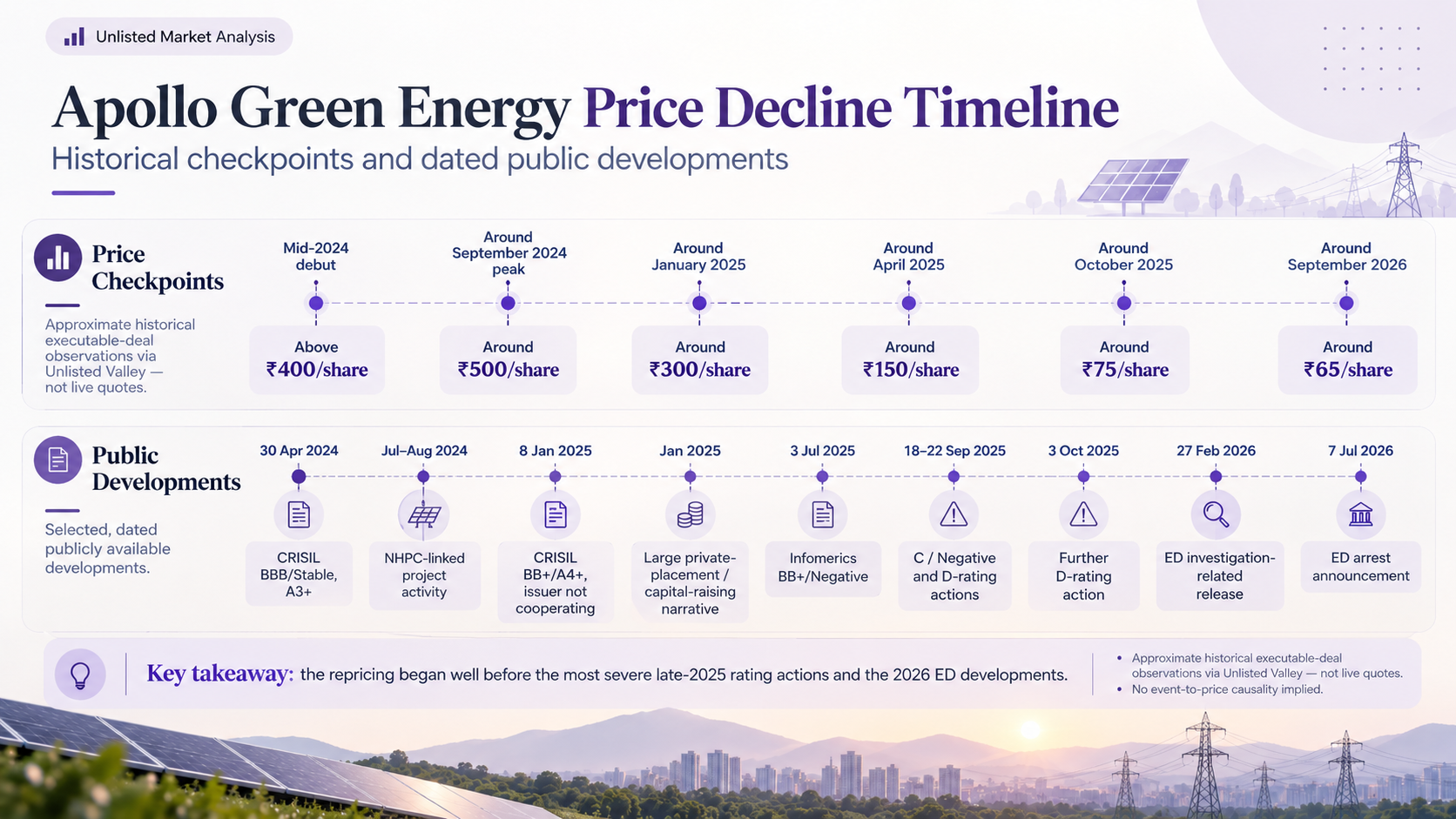
This sequence does not prove exactly what caused each price move. It does show that the September–October 2025 D ratings and the 2026 ED developments cannot explain the initial late-2024 to early-2025 decline on their own.
Sources: CRISIL — 30 April 2024, CRISIL — 8 January 2025, CRISIL — 22 September 2025, Apollo Green Energy Annual Report FY2024-25.
What Changed in Investor Expectations?
The ₹4,110 Crore Private-Placement Headline Needs Caution
A major financing narrative emerged around Apollo Green in early 2025, but the underlying records do not support treating ₹4,110 crore as cash that the company actually raised.
Moneycontrol later reported that a January 2025 board resolution contemplated 13.7 crore equity shares at ₹300 per share, which would imply a theoretical maximum size of about ₹4,110 crore if fully issued on those terms. The same report said only around ₹78 crore had reportedly been raised as of July 2025.
However, Apollo Green's signed FY2024–25 annual report creates an important reconciliation issue. Its preferential-issue table records the 20 January 2025 approval as 13,700,000 shares at ₹300 per share—1.37 crore shares, not 13.7 crore—while the report separately shows materially smaller actual FY2025 allotments than the headline proposal.
Because the public records do not reconcile cleanly, the safest conclusion is not that Apollo Green “raised ₹4,110 crore.” The useful investor takeaway is that a very large prospective capital-raising and dilution narrative was in the market, while actual issuance and realised funding were materially different from the maximum headline numbers being discussed.
That matters because a large proposed equity issue can change expectations about future dilution, funding requirements and per-share economics even before the full issue is completed. But proposed shares, shares actually allotted and cash actually raised must be kept separate.
Sources: Apollo Green Energy Annual Report FY2024-25.
Share Issuance Increased Dilution Concerns
The annual report gives clearer evidence that Apollo Green's equity base did expand materially.
The reported year-end share count moved from 1.90 crore shares at 31 March 2024 to 4,06,10,287 shares at 31 March 2025, with the latter figure including partly paid shares. The report also records multiple shareholder approvals for preferential issues at different prices during FY2025.
More shares do not automatically mean a company's total value must fall. But for an existing shareholder, new issuance can reduce proportional ownership and can change per-share valuation unless the growth in business value and earnings keeps pace with the larger equity base.
Because the annual report contains unreconciled details around proposed and partly paid shares, this article does not calculate a headline dilution percentage or treat every approved share as actually issued.
Source: Apollo Green Energy Annual Report FY2024-25.
2025 IPO Expectations Became Less Certain
IPO expectations were also part of Apollo Green's investment narrative.
In January 2025, CEO Sanjay Gupta told Moneycontrol that Apollo Green was looking to go public in the second half of 2025. Apollo Green later amplified an ET EnergyWorld interview on its own LinkedIn page saying it was preparing for an IPO in Q4 CY2025.
Those statements are evidence of a management/public expectation, not a formally confirmed listing timetable. The research for this article did not establish a filed DRHP or other formal timetable that would allow a particular historical price checkpoint to be labelled the result of a “missed IPO deadline.”
Still, the expectation itself matters. An unlisted or pre-IPO security may carry a premium when buyers expect a clearer route to listing. If a publicly discussed window becomes less visible or does not convert into a formal filing timetable, buyers may reduce the premium they are willing to pay. That is a plausible part of Apollo Green's expectation reset, but its exact price effect cannot be measured from the available transaction data.
Sources: Apollo Green Energy LinkedIn post on Q4 CY2025 IPO expectations.
What Other Factors May Have Pressured Apollo Green's Unlisted Valuation?
Lower Buyer Bids and Thin Unlisted-Market Liquidity
Unlisted-market price discovery is negotiated rather than continuously matched on an exchange.
Based on Unlisted Valley's market observations, buyers increasingly placed lower executable bids, while many existing holders were reluctant to sell at those levels because their acquisition prices were much higher. The pattern was therefore observed as a gradual repricing with occasional rebounds, rather than as a documented wave of forced selling or panic dumping.
A thin market can still move sharply. The next executable level may be set by a relatively small number of willing buyers and sellers even if most holders are not actively selling.
The available observations do not establish total buyer depth, seller distress, daily volume or the motives of every participant.
Liquidity and price-discovery risk are broader characteristics of the unlisted market; we explain these in more detail in our guide to risks of investing in unlisted shares
Revenue, Business Mix and Cash Conversion Raised Questions
Apollo Green was not loss-making in FY2025, but the audited financial picture was mixed.
Metric | FY2024 | FY2025 |
Standalone revenue from operations | ₹1,148.48 crore | ₹702.73 crore |
Standalone PAT | ₹29.57 crore | ₹34.89 crore |
Consolidated revenue from operations | ₹1,234.27 crore | ₹806.48 crore |
Consolidated PAT | ₹38.59 crore | ₹33.66 crore |
Operating cash flow was positive but substantially below reported profit: ₹8.28 crore standalone operating cash flow versus ₹34.89 crore standalone PAT, and ₹2.00 crore consolidated operating cash flow versus ₹33.66 crore consolidated PAT. Standalone unbilled revenue also increased from ₹53.43 crore to ₹141.03 crore.
The relevant concern is therefore not a simplistic “Apollo Green made a loss.” It is the combination of lower revenue, weaker profit-to-cash conversion, a mixed standalone/consolidated profit picture and a changing business mix.
The business-mix point also needs care. The FY2025 annual report contains multiple transfer/hive-off entries involving RK Eternanova Private Limited across the year. That makes it unsafe to reduce the revenue change to one isolated ₹48.60 crore transfer or to claim that restructuring fully explains the revenue decline.
There is also a chronology limitation: the final FY2025 standalone and consolidated statements were signed in November and December 2025. Those audited numbers should not be presented as though market participants definitively knew the same final figures during the earlier late-2024 or early-2025 price decline.
Source: Apollo Green Energy Annual Report FY2024-25.
Credit Signals Worsened Through 2025
Credit deterioration was progressive rather than one sudden September event.
CRISIL had reaffirmed Apollo Green at BBB/Stable and A3+ on 30 April 2024. On 8 January 2025, it migrated the ratings to BB+/Stable and A4+, issuer not cooperating, after the required no-default statements were not provided. That was an early information/credit signal, but “issuer not cooperating” is not automatically the same as a default.
Infomerics later moved its long-term rating to BB+/Negative, issuer not cooperating on 3 July 2025, then to C/Negative on 18 September 2025. CRISIL moved the bank-facility ratings to D on 22 September 2025, and Infomerics moved rated bank facilities/NCDs to D, issuer not cooperating on 3 October 2025.
These later actions were material and could reasonably affect buyer confidence and financing-risk perception. But by then Unlisted Valley's observations already showed a large decline from the September 2024 peak.
The rating-agency caveats also matter: several actions relied on best-available, limited or publicly available information. Rated facility size should not be treated as the same thing as actual outstanding debt.
Sources: CRISIL — 30 April 2024, CRISIL — 8 January 2025, CRISIL — 22 September 2025, Infomerics — 3 July 2025, Infomerics — 18 September 2025, Infomerics — 3 October 2025.
Broader Weakness in the Unlisted Market Added to the Backdrop
Apollo Green's repricing also unfolded during a period of weaker sentiment and thinner activity across parts of India's unlisted and pre-IPO market.
Moneycontrol reported broader unlisted-share weakness in August 2025 and lower trading activity again in July 2026. That market backdrop could make buyers more price-sensitive, but it is only contextual evidence. Market-wide volume estimates cannot be applied directly to Apollo Green or to Unlisted Valley's transaction activity.
Why Did the Price Fall Even Though Apollo Green Was Profitable and Winning Projects?
Because profitability and project awards are only part of what determines a negotiated unlisted-share valuation.
Apollo Green's FY2025 standalone PAT increased from ₹29.57 crore to ₹34.89 crore, and the company continued to secure meaningful renewable-energy work. NHPC awarded Apollo Green the 200 MW Khavda Stage-I solar EPC contract on 5 August 2024, with a disclosed project cost of ₹929 crore including five years of operations and maintenance. NHPC also identified Apollo Green as contractor for the 50 MW West Kallada floating-solar project awarded in July 2024.
Those are important positives. But a project award is not the same as project profit, cash collection or completed execution. Buyers can simultaneously recognise a healthy order pipeline while assigning a lower per-share value because their expectations around funding, dilution, cash conversion, credit risk, IPO timing or liquidity have changed.
That is why “the company was profitable” and “the share price fell” are not contradictory statements.
Did the ED Investigation Cause Apollo Green's Share Price Fall?
It cannot explain the initial decline.
In a 27 February 2026 press release, the Enforcement Directorate said that certain corporate houses, including Apollo Green Energy, had allegedly availed large private loans from private financiers in its investigation involving Inderjeet Singh Yadav and others. The properties described as provisionally attached in that release were stated to belong to Inderjeet Singh Yadav and his wife, not to Apollo Green Energy.
On 7 July 2026, the ED announced the arrest of Rakesh Gupta, Apollo Green Energy's former CFO/President–Strategic Initiatives, in the ongoing investigation.
These are investigation-related actions and allegations, not by themselves a court finding that Apollo Green Energy was guilty of wrongdoing. They may have affected later risk perception, but the available evidence does not quantify any price effect.
More importantly for this article's central question, Unlisted Valley had already observed Apollo Green moving from around ₹500 in September 2024 to around ₹150 by April 2025 before these 2026 developments occurred.
Sources: Directorate of Enforcement — 27 February 2026, Directorate of Enforcement — 7 July 2026.
Other Creditor-Initiated IBC Proceedings Are Later Risk Context
Separate from the ED investigation, tribunal records also show creditor-initiated Section 9 IBC proceedings involving Apollo Green Energy.
A National Company Law Tribunal cause list dated 15 December 2025 listed Voyager Trading Partners LLC v. Apollo Green Energy Limited (IB/581/ND/2025) as pending for admission. In Royal Cap House v. Apollo Green Energy Limited (IB/611/ND/2025), a National Company Law Appellate Tribunal order dated 22 July 2026 described the underlying Section 9 petition as still at the hearing stage and allowed Apollo Green to cure defects in its reply. In Power2SME Pvt. Ltd. v. Apollo Green Energy Limited (CP-IB-112/ND/2026), the NCLAT on 14 July 2026 allowed Apollo Green to file its reply and requested the NCLT to dispose of the petition at the earliest.
These records are relevant as later financing and legal-risk context, but they should not be read as proof that Apollo Green had been admitted into a corporate insolvency resolution process or that the creditor claims had been decided on their merits. The cited appellate orders dealt with procedural rights to file replies, not final adjudication of the underlying claims. They also came well after the initial 2024–early-2025 share-price decline and therefore cannot explain that earlier repricing.
Sources: NCLT cause list — 15 December 2025, NCLAT order reproduced by Indian Kanoon — Royal Cap House, 22 July 2026, NCLAT order reproduced by Indian Kanoon — Power2SME, 14 July 2026.
What Can Investors Actually Conclude From the Decline?
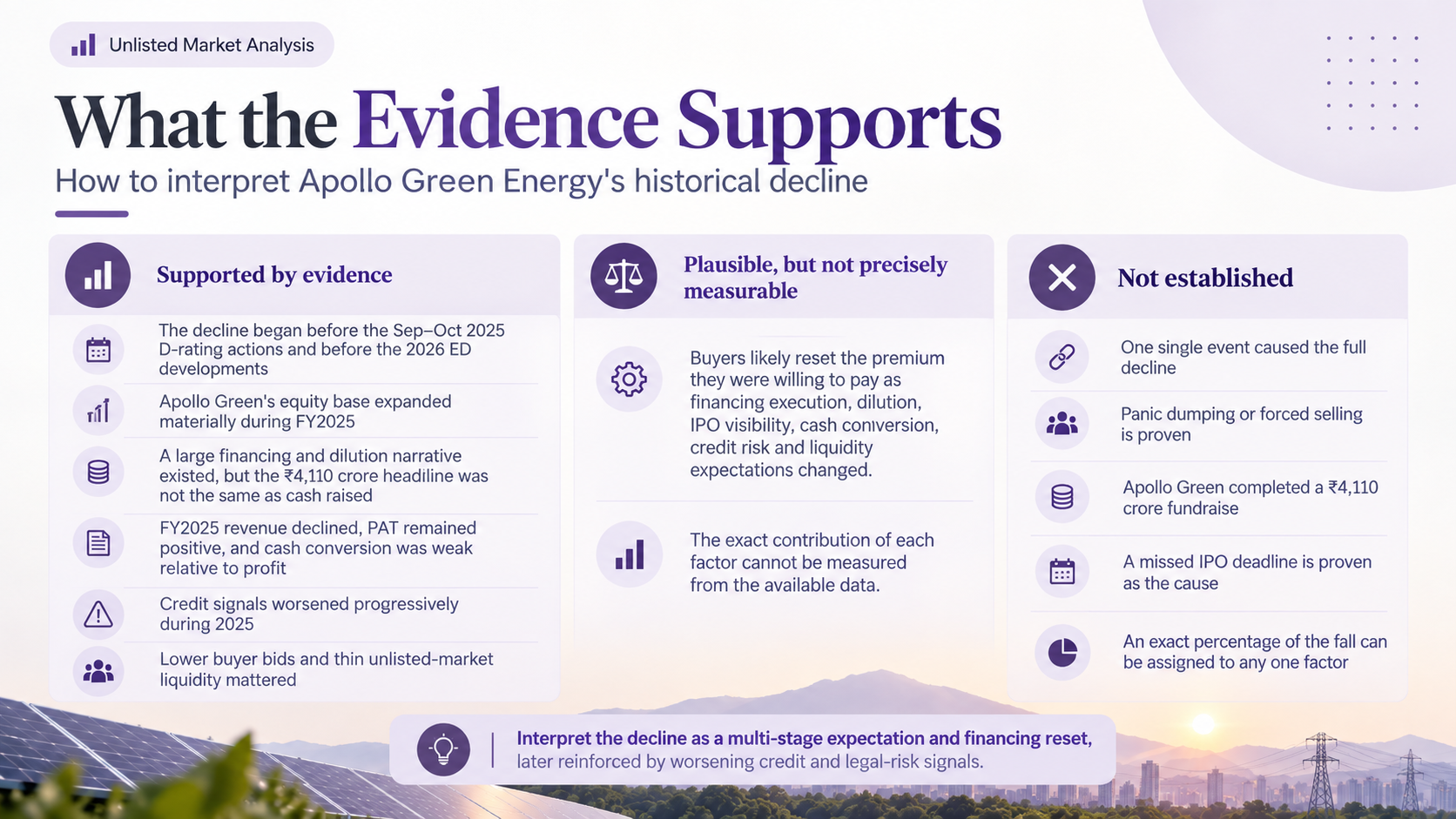
The available evidence supports a multi-stage repricing, not a single-cause story.
Supported by evidence:
- Apollo Green's unlisted-share repricing began before the September–October 2025 D ratings and the 2026 ED developments.
- Unlisted Valley observed lower executable levels, lower buyer bids, holder reluctance at lower prices and occasional rebounds.
- Apollo Green's issued/share-capital base expanded materially during FY2025.
- A large capital-raising/private-placement narrative existed, but the ₹4,110 crore headline is not the same as cash raised and the underlying share-count records are not fully reconciled.
- Public management communication created a 2025 IPO expectation, but this research did not establish a formal listing timetable that can be tied to a specific price move.
- FY2025 revenue declined, profitability remained positive, cash conversion was weak relative to PAT and the standalone/consolidated picture differed.
- Credit signals deteriorated progressively during 2025, with the most severe default-category actions arriving later in the decline.
- Major project wins and positive profit existed alongside these financing, credit and liquidity concerns.
- Later ED developments and creditor-initiated IBC proceedings added further legal/financing-risk context, but the cited records do not establish that those later events caused the initial decline or that the creditor claims were finally decided on their merits.
Plausible, but not precisely measurable: buyers likely reduced the premium they were willing to pay as financing execution, dilution, IPO optionality, cash conversion, credit and liquidity expectations changed at different stages.
Not established: one event causing the full decline, panic dumping, forced selling, a completed ₹4,110 crore fundraise, a proven missed IPO deadline, or an exact percentage of the price fall attributable to dilution, ratings, financials, legal developments or wider market sentiment.
The most useful way to read Apollo Green Energy's historical decline is therefore as an expectation and financing reset that unfolded in stages and was later reinforced by worsening credit and legal-risk signals, rather than as one event suddenly destroying value.
Readers looking for the current Apollo Green Energy unlisted share price or current transaction availability should use the service page. The historical levels in this article are not live quotes.
Disclosure and Data Note
Unlisted Valley participates commercially in the unlisted-share market. The historical transaction checkpoints in this article are first-party observations from executable deals seen through Unlisted Valley and are presented approximately because they are not a complete market-wide trade series.
This article is for informational purposes and does not constitute investment advice, a target price or a recommendation to buy or sell Apollo Green Energy shares. Unlisted-share prices and liquidity can change materially, and historical transaction levels should not be treated as current prices.