What Are Unquoted Shares? Meaning & Simple Explanation
Published: Updated: 12 min read
Unquoted shares are shares that do not have a regular qualifying quotation on a recognised stock exchange. In everyday investing, “unquoted shares” and “unlisted shares” are commonly used interchangeably, particularly when referring to shares of unlisted or pre-IPO companies.
If you have come across the term “unquoted shares” in a news article, company document, tax discussion, or investment conversation, the terminology can be confusing at first. What does unquoted actually mean? Is it the same as unlisted? Can you buy or sell these shares? And if there is no exchange price, how are they valued?
This guide explains the meaning of unquoted shares, where they trade, how their price is determined, and what you should know about their valuation, taxation and risks.
What Are Unquoted Shares?
In simple terms, unquoted shares are shares that do not have a regular qualifying quotation on a recognised stock exchange.
For example, shares of a private company are generally not traded on exchanges such as the NSE or BSE. Since there is no continuously updated exchange price for these shares, they are commonly referred to as unquoted or unlisted shares.
The term can also appear in a more technical tax context. Under the Income-tax Act, a “quoted share” is defined by reference to a share quoted on a recognised stock exchange with regularity, where the quotation is based on current transactions made in the ordinary course of business. A share that does not meet that definition is treated as a share other than a quoted share for provisions such as Section 50CA.
For most investors, however, the simple meaning is enough:
Unquoted shares are shares without a regular publicly available quotation on a recognised stock exchange.
Are Unquoted Shares the Same as Unlisted Shares?
In most investment contexts, yes.
“Unquoted shares” and “unlisted shares” are commonly used as interchangeable terms when discussing shares that are not traded on a recognised stock exchange.
There is a technical difference in how the words can be used in certain legal and tax provisions. Unlisted generally describes the listing status of a security, while quoted can refer to whether the security meets a specific definition based on its market quotation.
For a typical unlisted company or pre-IPO company, however, this distinction usually does not change the practical meaning for an investor. The shares will generally be both unlisted and unquoted.
So, if you are simply trying to understand the terminology:
Unquoted shares ≈ unlisted shares
The word “unquoted” becomes more important when you encounter specific tax or valuation provisions that use “quoted” and “unquoted” as defined terms.
Quoted vs Unquoted Shares
The easiest way to understand unquoted shares is to compare them with quoted shares.
Feature | Quoted shares | Unquoted shares |
Exchange quotation | Regular qualifying quotation available | No regular qualifying quotation |
Exchange trading | Generally traded on a recognised exchange | Not traded through the normal exchange market |
Live market price | Generally available | Generally unavailable |
Price discovery | Primarily through market trading | Negotiation, transactions and valuation |
Liquidity | Generally higher | Generally lower |
Valuation | Exchange price can provide a readily available reference | May require additional valuation methods |
An unquoted share generally does not have that same continuous price discovery mechanism. Its value or transaction price may therefore require more information about the company and the particular transaction.
Unquoted vs Unlisted vs Delisted Shares
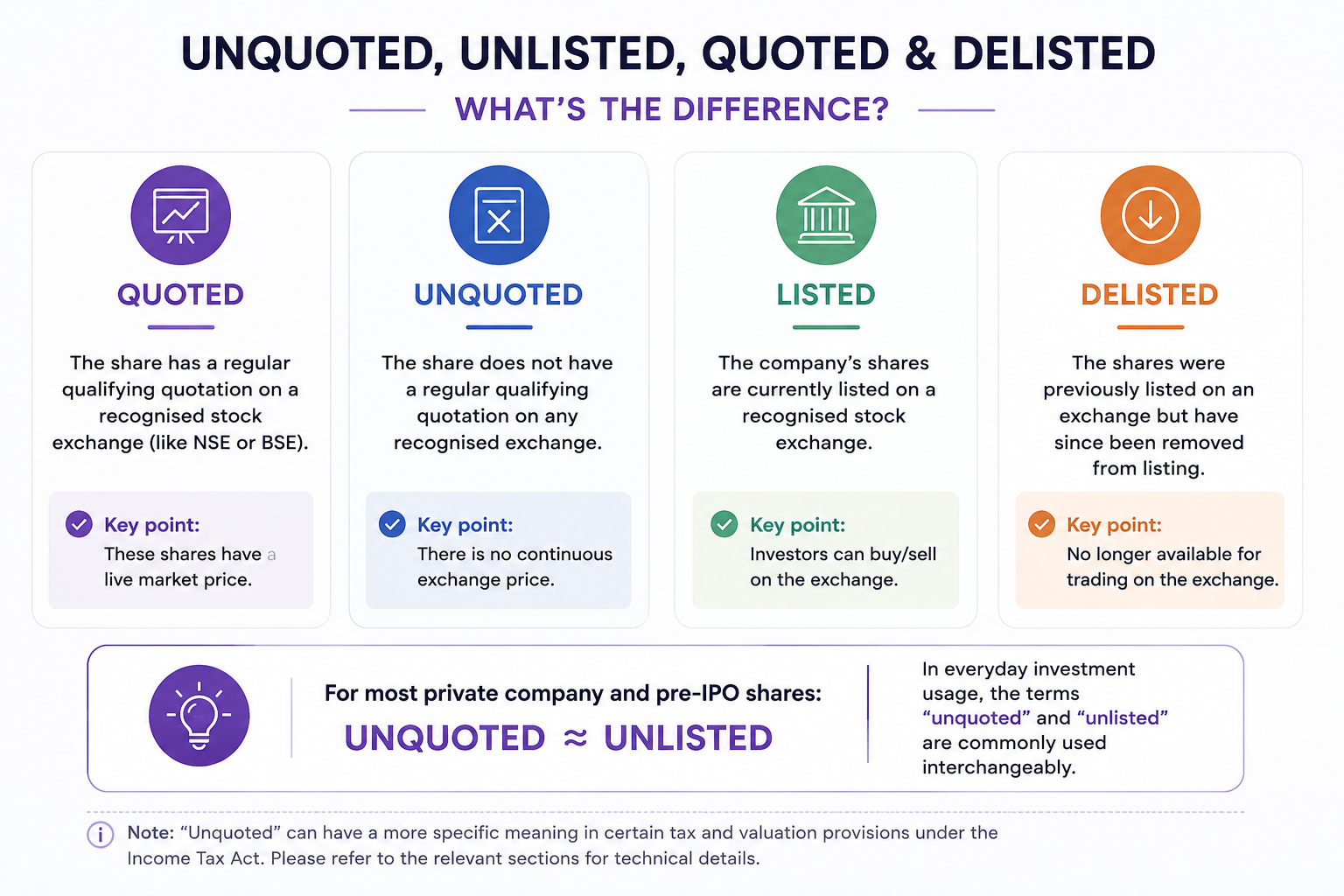
Unquoted and unlisted are commonly used interchangeably in everyday investing, but delisted has a different meaning.
What are unlisted shares?
An unlisted share is a share that is not currently listed on a recognised stock exchange.
Shares of private companies and companies preparing for an IPO like NSE and Zepto are common examples.
What are unquoted shares?
An unquoted share generally refers to a share that does not have a regular qualifying quotation on a recognised stock exchange.
In ordinary investment discussions, this is commonly used to describe the same broad category of shares as unlisted shares.
What are delisted shares?
A delisted share is different because it refers to a share that was previously listed but has subsequently been removed from listing.
For example, a company's shares may have traded on a recognised stock exchange and later become delisted. The shares may continue to exist after delisting, but they would no longer trade through the normal exchange market.
The simplest way to remember the terms is:
Unlisted: Not currently listed on a recognised stock exchange.
Unquoted: No regular qualifying exchange quotation.
Delisted: Previously listed but subsequently removed from listing.
Examples of Unquoted Shares
Unquoted shares can occur in several common situations.
1. Private company shares
Shares of private companies are generally not listed on recognised stock exchanges. They therefore normally do not have a public exchange quotation.
2. Pre-IPO shares
A company preparing for an IPO may have shares held by existing shareholders or private-market investors before its shares become publicly listed.
These shares are commonly described as pre-IPO or unlisted shares and are generally unquoted before listing.
3. Certain employee or promoter holdings
Shares held by employees, founders or promoters can also be unquoted where the shares do not have a qualifying exchange quotation.
The exact treatment can depend on the nature of the shares and any applicable restrictions.
4. Shares of delisted companies
Shares can continue to exist after a company has been delisted, although they no longer have the normal exchange quotation associated with their previous listing.
These are common examples rather than a universal legal classification. The precise treatment of a particular share can depend on the relevant law and the purpose for which the classification is being considered.
Where Do Unquoted Shares Trade?
Unquoted shares do not trade through the normal order book of a recognised stock exchange.
Instead, transactions may take place through private or negotiated arrangements, subject to applicable legal and contractual requirements.
For example, a transaction may involve:
- a direct transaction between a buyer and an existing shareholder;
- a private-market intermediary;
- a negotiated secondary transaction; or
- another permitted off-exchange transfer arrangement.
The important point is that the absence of an exchange quotation does not mean that the shares have no market or cannot be transferred.
However, transferability can depend on factors such as the company's Articles of Association, shareholder agreements, lock-in conditions and applicable legal or regulatory requirements. Section 56 of the Companies Act, 2013 sets out requirements relating to the transfer and registration of securities, while private companies can have restrictions on the transfer of their shares through their articles.
How Is the Price of an Unquoted Share Determined?
Unlike a listed share with a continuously updated exchange price, an unquoted share generally does not have a single publicly visible market price.
Its transaction price may be influenced by factors such as:
- the company's revenue and profitability;
- financial position and assets;
- growth prospects;
- valuations of comparable companies;
- recent investment or secondary transactions;
- demand from potential buyers and sellers; and
- the terms of the particular transaction.
For example, if an investor wants to purchase shares of a private company from an existing shareholder, the parties may negotiate a price based on the company's financial performance, previous funding rounds, comparable valuations and expectations about the business.
This is why the price of an unquoted share may not be as transparent as the price of a listed share.
Transaction price vs fair market value
It is also important to distinguish between the price at which two parties agree to transact and the fair market value (FMV) determined under a particular valuation framework.
They are not necessarily the same.
This distinction becomes particularly relevant when unquoted shares are being considered for tax purposes.
How Are Unquoted Shares Valued?
There is no single valuation method that applies to every situation involving unquoted shares.
Depending on the purpose of the valuation, factors such as the company's financial statements, assets, liabilities, comparable companies, cash flows and recent transactions may be considered.
For certain tax purposes, Indian income-tax rules contain prescribed methods for determining the fair market value of unquoted shares.
For example, Rule 11UA provides prescribed methods for determining the FMV of unquoted equity shares in specified circumstances. The rule includes a formula-based approach for unquoted equity shares based on specified values of assets and liabilities and the relevant paid-up equity share capital.
The applicable valuation method depends on the purpose of the valuation and the specific tax provision involved.
Therefore, the price agreed between a buyer and seller and the FMV calculated under a prescribed tax rule should not automatically be assumed to be identical. For a deeper explanation, see our guide to unlisted share valuation.
Why Do Unquoted Shares Matter for Tax?
The term “unquoted” becomes particularly important in certain Indian tax provisions.
For example, Section 50CA of the Income-tax Act applies to the transfer of a capital asset that is a share of a company other than a quoted share. Where the consideration for a qualifying transfer is lower than the prescribed fair market value, the prescribed value can be treated as the full value of consideration for calculating capital gains, subject to the applicable conditions and exceptions.
For valuation under Section 50CA, Rule 11UAA specifically provides the mechanism for determining the fair market value of a share that is not a quoted share. The Income Tax Department also identifies Rule 11UAA as the rule for valuation of unquoted shares for Section 50CA.
This is one reason you may encounter the term “unquoted shares” in tax documents even though investment websites commonly use “unlisted shares.”
For most investors, the practical takeaway is:
Unquoted and unlisted generally refer to the same broad category in everyday investment discussions, but “unquoted” is also used as a defined concept in certain tax and valuation provisions.
Tax treatment can depend on the type of transaction, taxpayer, security, date and applicable provisions. Specific transactions should therefore be reviewed with a qualified tax professional.
For a deeper explanation, see our guide to unlisted share taxation.
Are Unquoted Shares Legal to Buy and Sell in India?
The fact that shares are unquoted does not by itself make them illegal or non-transferable.
Whether a particular transaction can be carried out depends on the nature of the shares and the applicable legal and contractual requirements.
These may include:
- the company's Articles of Association;
- shareholder agreements;
- lock-in restrictions;
- applicable securities regulations;
- transfer documentation;
- stamp duty and tax requirements; and
- applicable settlement or dematerialisation requirements.
The Companies Act contains requirements governing the transfer and registration of securities, and private companies may have additional restrictions on transfers through their articles.
So, while unquoted shares can be transferred in appropriate circumstances, not every unquoted share can necessarily be transferred freely.
Are Unquoted Shares Regulated by SEBI?
It depends on the security, issuer, transaction and applicable regulatory framework.
The fact that a share is unquoted does not automatically mean that it falls outside all regulation.
SEBI has regulations covering various securities, issuers and market activities, while company law and other regulations can also apply depending on the circumstances.
The safest way to think about it is:
Unquoted does not mean unregulated.
The exact regulatory position should be determined based on the particular security and transaction.
What Are the Risks of Unquoted Shares?
Unquoted shares can have different risk characteristics from actively traded listed shares.
Lower liquidity
There may not be a ready exchange market where you can immediately sell the shares.
Finding a buyer can therefore take more time than selling a liquid listed security.
Limited price transparency
There is usually no continuously updated exchange price that all market participants can see.
This can make it harder to determine whether a particular transaction price represents good value.
Valuation uncertainty
Without a continuous market price, valuation can depend more heavily on assumptions about the company's financial performance, growth prospects and comparable businesses.
Transfer restrictions
Some unquoted shares may have restrictions on who can buy them or how they can be transferred.
These restrictions should be checked before entering into a transaction.
Limited public information
Private and unlisted companies may have less publicly available information than widely traded listed companies.
Investors may therefore need to carry out more independent research before making an investment decision.
Frequently Asked Questions About Unquoted Shares
What are unquoted shares?
Unquoted shares are shares that do not have a regular qualifying quotation on a recognised stock exchange. In everyday investment usage, the term is commonly used interchangeably with unlisted shares.
Are unquoted shares the same as unlisted shares?
In most investment contexts, yes. Both terms are commonly used for shares that are not traded on a recognised stock exchange. “Unquoted” can have a more specific meaning in certain tax and valuation provisions.
What is the difference between quoted and unquoted shares?
Quoted shares have a regular qualifying quotation on a recognised stock exchange. Unquoted shares do not have such a regular exchange quotation.
What is the difference between unquoted and delisted shares?
An unquoted share does not have a regular qualifying exchange quotation. A delisted share specifically refers to a share that was previously listed but has subsequently been removed from listing.
Where do unquoted shares trade?
They do not trade through the normal order book of a recognised stock exchange. Transactions may instead take place through private, negotiated or other permitted off-exchange arrangements.
If you are researching an unquoted or unlisted share as a potential investment, Unlisted Valley provides access to a range of unlisted and pre-IPO shares, along with company information and relevant market details to help you research an opportunity.
How is the price of an unquoted share determined?
There is generally no continuously updated exchange price. The transaction price can depend on company financials, valuation, comparable companies, recent transactions, demand and the terms agreed between the parties.
Can you sell unquoted shares?
An unquoted share can be transferred where the applicable law, company documents and other restrictions permit it. However, finding a buyer can be more difficult than selling a liquid listed share.
How are unquoted shares valued for tax purposes?
Indian tax rules contain prescribed valuation mechanisms for unquoted shares in specific situations. Section 50CA and Rule 11UAA can be particularly relevant when determining the tax treatment of certain transfers.
Are unquoted shares regulated by SEBI?
It depends on the security, issuer, transaction and applicable regulations. Unquoted does not automatically mean unregulated.
Key Takeaway
If you are new to the term, the simplest way to understand unquoted shares is:
Unquoted shares are shares without a regular qualifying quotation on a recognised stock exchange. In everyday investing, “unquoted shares” and “unlisted shares” are commonly used to describe the same broad category.
The term “delisted” is different: it refers specifically to shares that were previously listed but have subsequently been removed from listing.
For most investors, the absence of an exchange quotation mainly means that price discovery, liquidity and valuation work differently from listed shares.
If you are researching a specific unlisted or pre-IPO company, the next step is to look beyond the label “unquoted” and evaluate the company, valuation, liquidity, financials, transfer conditions, and applicable tax implications.