India Gold Metaverse (IGM) Business Model: How Its Gold Ecosystem Works
Published: 9 min read

India Gold Metaverse is building gold-related commerce and technology businesses around bullion trading, jewellery discovery, purity assessment and physical/digital gold products. Its FY26 operating revenue came from bullion sales. The broader business model also includes product and partnership propositions whose individual revenue contributions are not yet separately established.
For an equity investor, these are company businesses to evaluate. Buying IGM shares gives an interest in the company; it does not give ownership of a specified quantity of gold.
The current legal name is India Gold Metaverse Limited, formerly India Gold Metaverse Private Limited. Its annual report records conversion to a public limited company on 7 August 2026; the current name also appears in its GoldSense terms.
Business information as of 6 October 2026. Financial figures below cover the years ended 31 March 2025 and 31 March 2026.
IGM’s four business offerings
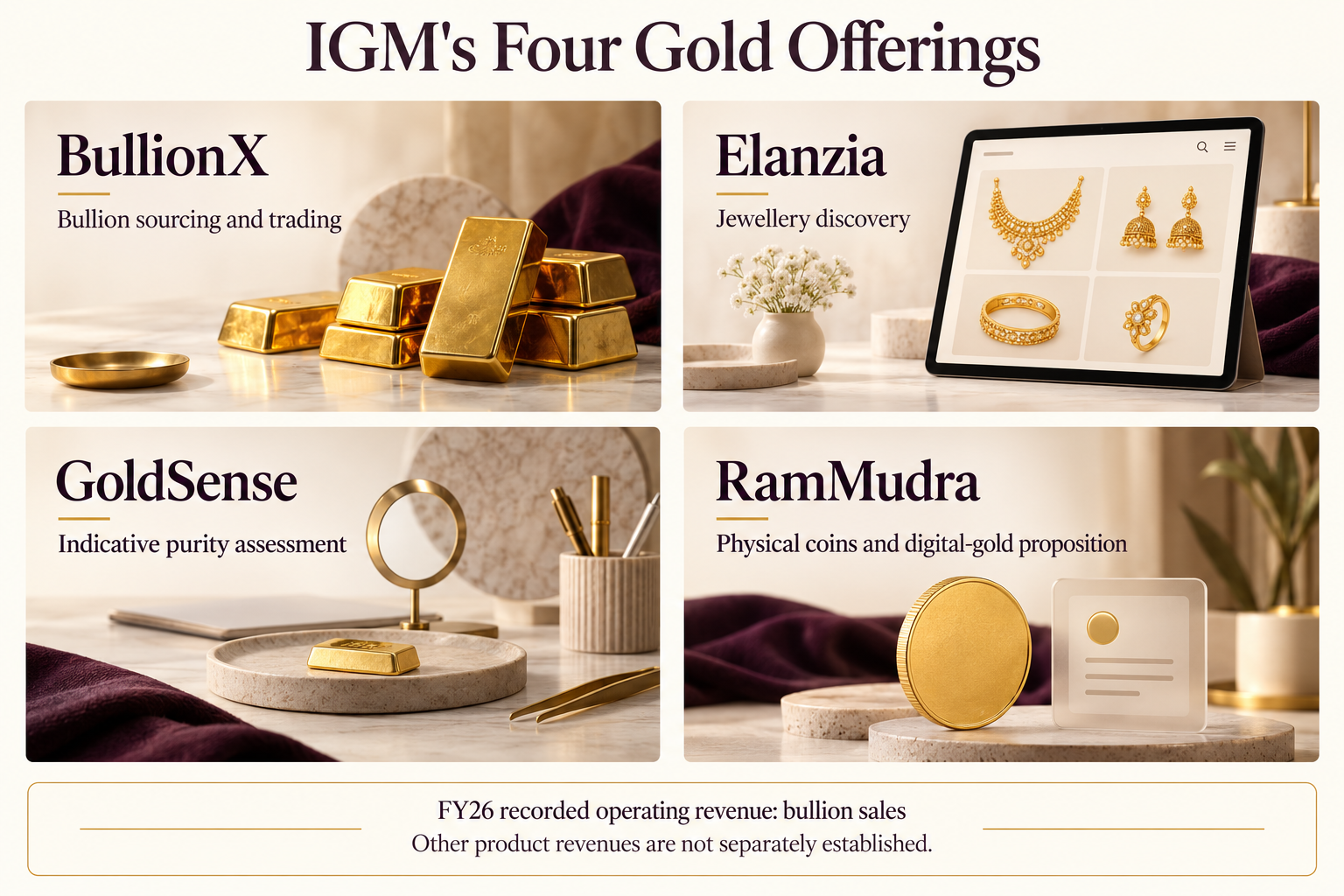
The company’s current offering brings together four named businesses. Each addresses a different part of the gold trade.
Offering | Intended customers | What it offers |
BullionX | Bullion dealers, jewellers and professional/institutional users | Gold and silver sourcing, pricing and trading tools |
Elanzia | Independent jewellers and jewellery buyers | Multi-jeweller discovery, digital catalogues and virtual try-on |
GoldSense | Jewellers, banks, NBFCs and other gold-evaluation users | A portable purity-assessment device and connected application |
RamMudra | Gold buyers and distribution partners | Physical gold coins and a blockchain-enabled digital-gold proposition |
Source: IGM’s official BullionX, Elanzia, GoldSense and RamMudra pages. Intended customers describe the offerings, not measured paying-user numbers.
Three points help interpret this model:
- Bullion turnover includes the value of the metal sold. It is different from earning a platform fee on a transaction.
- A launch or demonstration establishes a product milestone; paid adoption and repeat business need their own evidence.
- Commercial progress needs to be assessed alongside costs and cash generated or used by operations.
BullionX: sourcing and trading bullion
BullionX is presented as a professional gold and silver trading platform, combining pricing, order execution, market information and physical delivery. Jewellers and dealers can use such infrastructure to source metal for their businesses.
IGM’s FY26 accounts establish that the company bought and sold bullion. They recognise the agreed sale value when ownership risks and rewards pass to the buyer. The accounts do not separately identify BullionX-branded platform fees or show how much activity passed through the branded platform.
That matters because a large bullion-sales figure can coexist with a much smaller trading contribution after the cost of the metal. Sales alone do not demonstrate the economics of a recurring-fee technology platform.
Source: India Gold Metaverse Annual Report 2025–2026, standalone accounting policy and revenue note.
Elanzia: connecting digital discovery with jewellery stores
Elanzia helps independent jewellers display their collections digitally, with AI-assisted search and virtual try-on. Buyers can shortlist designs online and visit the partner jeweller for the physical experience and purchase.
The jeweller retains its own brand and pricing. IGM’s proposition is to supply the discovery and technology layer that supports that journey. This explains the service offered, but a commission rate, subscription tariff and separately recognised Elanzia revenue are not established by the available disclosures.
GoldSense: purity assessment and related workflows
GoldSense combines a portable gold-assessment device with an application for readings and digital records. Its terms contemplate a commercial device sale under a separate buyer agreement.
IGM’s event record describes a GoldSense launch at the 20–23 August 2026 India Gold Conference and the inauguration of three Mumbai Tunch centres, or gold-testing centres, on 24 September. These are company-announced milestones; they do not quantify units sold or recognised revenue.
The product’s use has an important boundary. Its terms, updated 10 September 2026, describe purity readings as indicative and distinguish them from certified assaying or hallmarking. They also advise against using a reading as the sole basis for commercial or financial decisions.
IGM describes a role in connecting borrowers with banks and NBFCs. That facilitation role does not establish that IGM itself lends money or earns loan interest.
RamMudra: physical coins and digital gold
RamMudra describes two offerings: physical 24K gold coins and digital gold with blockchain-recorded ownership. The company also seeks distribution relationships with businesses such as jewellers and financial platforms.
The physical and digital propositions involve different customer rights. A description of gold backing or redemption is not sufficient to establish the digital product’s enforceable custody arrangements, reserve coverage or redemption conditions. As of 6 October, those details and completed digital-launch status remain unresolved in the available materials.
For category context, SEBI’s 8 November 2025 caution distinguishes digital-gold products from products covered by its securities and commodity-derivatives protection framework. It is a general caution, not an IGM-specific finding.
How does India Gold Metaverse make money?
IGM’s reported operating revenue in FY26 was bullion-sales revenue. Its wider monetisation picture can be separated into three levels:
Revenue route | What is established |
Bullion sales | Recorded in IGM’s audited FY26 standalone accounts |
GoldSense device sales | A sale mechanism is documented in the product terms; revenue and units are not separately quantified |
Partnership memberships | An earlier official outreach proposal contemplated paid memberships; current fees, uptake and earned income remain unresolved |
Sources: India Gold Metaverse Annual Report 2025–2026, revenue note; GoldSense terms; official partnership proposal.
The membership proposal retained March, April and July 2026 rollout targets and expressly described the expression of interest as nonbinding, with a separate agreement to follow. It should therefore be read as a proposed commercial route, not as proof that membership fees have been earned.
IGM also presents education through its Academy and lending facilitation within the ecosystem. Separate fee contributions from those activities are not quantified. Likewise, subscriptions, commissions or custody fees should not be assumed for every named product.
The intended connection between the businesses is practical: sourcing metal, helping buyers discover jewellery, supporting purity assessment and offering gold products. Common infrastructure could support that journey, but realised cross-selling and its contribution to revenue are not yet measured in the disclosures used here.
 What FY26 accounts reveal about the business model
The accounts show the start of operating revenue from bullion commerce, alongside a loss and continued operating cash use.
IGM audited standalone financials; ₹ crore. FY25 and FY26 are the years ended 31 March 2025 and 31 March 2026 respectively.
Metric | FY25 | FY26 |
Operating revenue / bullion sales | 0.00 | 51.87 |
Other income | 5.30 | 3.68 |
Loss after tax | −2.98 | −32.46 |
Net cash from / used in operating activities | −52.86 | −11.33 |
Source: India Gold Metaverse Annual Report 2025–2026, audited standalone statements and notes 15–16; PDF pages 31–32 and 44. Figures converted from ₹ lakh to ₹ crore and rounded to two decimals.
The change from zero operating revenue to bullion sales is meaningful, but it does not prove that all four offerings generated income. Nor should ₹55.55 crore of FY26 total income be labelled operating revenue: that total includes ₹3.68 crore of other income, principally investment gains and interest.
Costs extended beyond bullion purchases. The accounts include research and development, employees, professional services and sales promotion, as well as hedging/trading losses. Attributing the entire loss to technology investment would overlook those other expenses.
Operating cash outflow was smaller than in FY25, but it remained negative. This measures cash used by operations during the financial year; it does not establish the company’s October cash position or funding runway.
Source: India Gold Metaverse Annual Report 2025–2026, standalone cash-flow statement and expense notes.
There is also material funding context after the year-end. A PTI report published on 27 July 2026 described an approximately ₹300 crore private-equity transaction that included a secondary placement. It said primary proceeds were intended for technology development, product commercialisation and ecosystem expansion.
Primary funding comes from issuing new shares, with proceeds going to the company. Secondary sales transfer existing shares, with proceeds going to the selling shareholders. The reported transaction total therefore cannot be treated as entirely fresh cash received by IGM. The report does not give the split, and the headline amount should not be added to March balances to calculate current liquidity.
Where 63 moons and IGMTech fit
IGM identifies 63 moons as its technology partner. That relationship has an established financial history: IGM’s accounts record ₹6 crore of related-party software-development R&D in FY26, compared with ₹3 crore in FY25. The 63 moons FY26 annual report records matching software-service income from IGM.
These amounts describe a service cost for IGM and income for its vendor. They are not revenue earned by IGM from its own customers.
The May 2026 postal-ballot notice proposed a long-term IGMTech development, licensing and maintenance arrangement. Its disclosed terms included ₹25 crore payable in FY27 and another ₹25 crore before March 2029, plus ₹12 crore annual fixed charges subject to agreed revisions and additional variable/manpower charges. The voting-result filing establishes shareholder approval effective 20 June 2026.
Approval is distinct from execution of the agreement or completion of payments. For the business model, the disclosed structure makes technology-service commitments a relevant cost and dependency to monitor as commercial activity develops.
What investors should watch next
The next useful evidence would show how product activity translates into repeat revenue and sustainable economics:
- Bullion commerce: repeat customer activity, trading contribution after metal costs, and cash conversion.
- Elanzia: active participating jewellers, completed purchases and an explicitly disclosed fee model.
- GoldSense: paid device sales, support costs, repeat institutional use and validation appropriate to the intended use.
- RamMudra: clear customer terms, custody and redemption arrangements, and evidence of commercial activity.
- Shared infrastructure: actual technology-service costs and evidence that connecting the offerings improves revenue or operating efficiency.
These are monitoring questions, not forecasts or numerical targets. They focus on the gap between offering a product and demonstrating its contribution to company earnings.
For current commercial information, see Unlisted Valley’s IGM unlisted-share price and transaction details.
FAQs
Does an IGM share give ownership of gold?
No. An IGM share represents equity in India Gold Metaverse. Rights attached to a physical or digital gold product arise from that product’s terms; they are separate from ownership of company shares.
Does a higher gold price guarantee higher IGM profits?
No. Higher gold prices may change the value of bullion transactions, but company profitability also depends on purchase costs, trading outcomes, product income and operating expenses. A rise in metal prices does not establish a corresponding rise in IGM earnings or share value.
Is IGM a subsidiary of 63 moons?
In its May 2026 filing, 63 moons disclosed no direct or indirect equity holding in IGM. It identified IGM as a related party through promoter-linked ownership, while IGM describes 63 moons as its technology partner. This dated disclosure should not be treated as verification of ownership changes after May.
Sources
- India Gold Metaverse, Annual Report 2025–2026 — audited standalone financial statements and notes.
- IGM official offerings and GoldSense terms, updated 10 September 2026.
- 63 moons Annual Report 2025–2026 and the linked May–June 2026 corporate filings.
- IGM partnership proposal — historical outreach plan.
- PTI funding report, 27 July 2026.
- SEBI digital-gold caution, 8 November 2025.
Disclosure
Unlisted Valley facilitates transactions in unlisted shares and has a commercial interest in this market. This article provides general company information and analysis, not personalised investment advice. Investments in unlisted shares involve business, liquidity and valuation risks.