Goodluck Defence Business Model: 155mm Shells and Capacity Expansion
Published: Updated: 6 min read

Goodluck Defence and Aerospace Limited (GDAL) manufactures empty artillery shell bodies for domestic and export customers. Its disclosed annual capacity is 1.5 lakh shells, with an expansion planned to take the total to 4 lakh. The business depends on converting that manufacturing capability into approved products, accepted deliveries and revenue.
The company's FY26 operating update records its first overseas dispatch of 155mm empty shells. The larger capacity figure remains a target, rather than evidence of current production at that scale.
What does Goodluck Defence actually manufacture?
The clearest description of the disclosed business is ready-to-fill empty shell bodies. These are components supplied for subsequent ammunition completion; an empty body should not be treated as a complete, filled artillery round.
Goodluck India announced its subsidiary's industrial licence in October 2025. The disclosed scope covers 105mm, 120mm, 125mm, 130mm and 155mm shells, including M107 and ERFB variants in the 155mm category. A licence covering several products does not establish that each is already generating commercial sales.
Source: Goodluck India's licence announcement, 3 October 2025.
In July 2026, the Directorate General of Quality Assurance (DGQA) qualified the company to supply 155mm M107 ready-to-fill empty shells assembled with a recovery plug. This enables participation in relevant procurement opportunities, subject to tender conditions and contractual awards.
Source: DGQA qualification announcement, 27 July 2026.
The 28 October 2026 filing adds a separate product milestone: GDAL emerged as the sole technically qualified bidder for specialized 155mm HE M1A4 ready-to-fill shells to Munitions India Limited. Technical qualification does not establish that a contract has been awarded.
Source: 28 October 2026 board filing, attached business update.
Goodluck Defence is a subsidiary of Goodluck India Limited. The parent's wider engineering operations provide context, but their facilities, customers and contracts should be distinguished from the subsidiary's own disclosures.
How does the business model work?
Goodluck Defence supplies manufactured products under customer contracts. The commercial task extends beyond making a shell body: the supplied product must meet the order's requirements and pass the applicable acceptance process.
A June 2026 disclosure illustrates this. GDAL received an approximately ₹255 crore domestic order for 155mm long-range empty shells in ready-to-fill condition. Delivery was subject to successful end-user inspection and the requisite approvals, with execution scheduled within ten months. The buyer's identity was withheld for confidentiality.
Source: Domestic order disclosure, 19 June 2026.
For investors, this means manufacturing capability, an order award and completed delivery are different milestones. An announced order gives evidence of demand, while the delivery terms determine the work still required. Its original value should not automatically be described as today's remaining order book.
What is Goodluck Defence's manufacturing capacity?
The company disclosed an initial capacity of 1,50,000 shells annually. Its November 2025 update records the facility's inauguration and commencement of commercial production in October 2025.
Source: Q2/H1 FY26 business update, 8 November 2025.
The expansion plan adds 2.5 lakh shells to that base. A project update dated 6 August 2026 provides the following terms:
Expansion item | Disclosed position |
Existing annual capacity | 1,50,000 shells |
Planned additional annual capacity | 2,50,000 shells |
Planned total annual capacity | 4,00,000 shells |
Approximate project investment | ₹500 crore |
Planned funding sources | Equity and debt |
Completion target in the 6 August 2026 filing | September 2027 |
Source: Goodluck India project update, 6 August 2026. Figures describe the announced plan, not verified spending or completed expansion.
The timing disclosures are not fully aligned. On the 10 August 2026 earnings call, management discussed H1 FY28 in one answer but later agreed with Q4 FY28 (January–March 2028) for commercialization of the expansion. The sources do not reconcile the completion and commercialization milestones.
September 2027 is therefore a dated completion target, rather than a confirmed date for commercial ramp-up. As of 30 October 2026, commissioning of the expanded capacity remains unconfirmed.
Management attributed the delay to financial closure—the process of arranging the project's funding—and noted that regulatory approvals could affect timing.
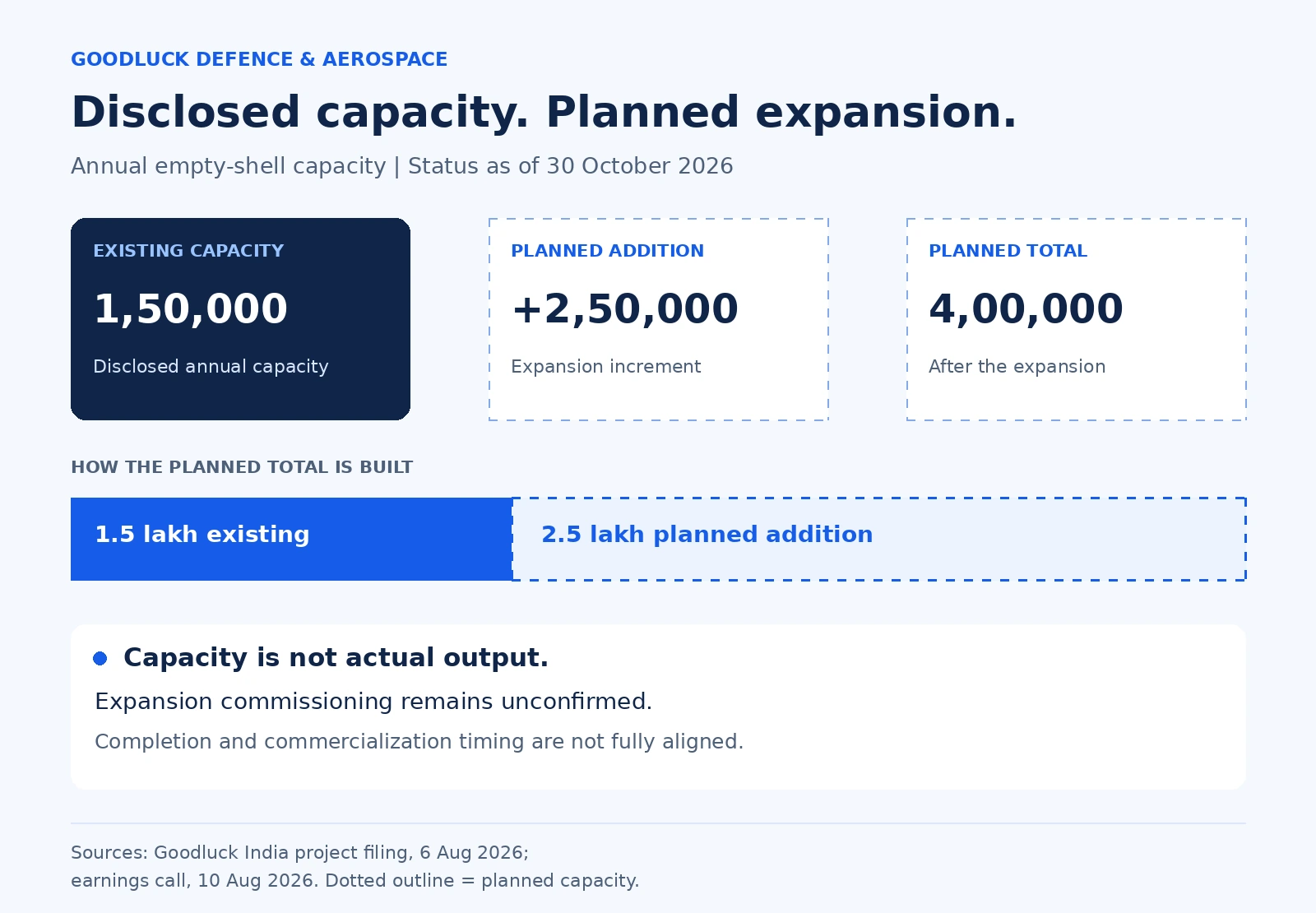
Sources: 6 August 2026 project update and 10 August 2026 earnings-call transcript.
How much of that capacity is being used?
On the 10 August 2026 earnings call, management estimated shell-business utilization at roughly 60–70%, while saying the exact figure was not at hand. Asked about quarterly shell volumes, management did not supply an exact unit count. That comment is a dated approximation, rather than a current production statistic.
Source: Q1 FY27 earnings-call transcript, call held 10 August 2026.
Installed capacity describes the manufacturing scale available over a year. Actual output depends on utilization, product mix and successful production. Accepted deliveries and cash collection add further commercial tests. Multiplying planned capacity by an assumed selling price would therefore produce a scenario, not a reliable revenue forecast.
The 28 October filing says defence-order production was in its initial trial, testing and validation phase, with revenue contribution expected in the latter part of FY27. It does not identify the particular order. The earlier FY26 overseas dispatch and this later production update describe different commercial milestones; neither establishes full-capacity output.
Source: 28 October 2026 board filing, attached Q2/H1 FY27 business update.
What does the aerospace expansion add?
On 28 October 2026, the subsidiary's board approved aerospace components as a new business line within its previously approved overall capital outlay. The filing specifies an estimated investment of approximately ₹80 crore.
This is an approved expansion direction. It does not establish that aerospace manufacturing has been commissioned or that customer revenue has begun. Because the allocation sits within the existing outlay, adding it to the ₹500 crore project budget would overstate the disclosed total.
Source: 28 October 2026 board outcome and Annexure B.
Which developments should investors track next?
The most useful updates will show progress from the disclosed capacity plan to sustained commercial execution:
- Expansion commissioning: confirmation of additional usable capacity and any revision to the timetable.
- Production and deliveries: dated shell volumes, utilization and accepted shipments, keeping existing capacity separate from the expansion.
- Product-specific procurement: the difference between technical qualification and a contract award, followed by execution.
- Funding and collections: how investment is financed and whether customer deliveries translate into cash.
- Aerospace implementation: commissioning, product qualification and commercial orders following the board approval.
These milestones make the business easier to assess than a broad claim about worldwide ammunition demand. Capacity creates room to grow; the company's execution determines how much of that room becomes revenue and cash flow.
For indicative pricing and transaction enquiries, see the Goodluck Defence & Aerospace unlisted shares page.
Sources and scope
Information cutoff: 30 October 2026. The linked company and exchange disclosures distinguish historical production, product qualification, contract execution and future investment plans. Management utilization commentary is identified separately from confirmed output. This article does not forecast revenue, profits or investment returns.
Project timing draws on the 6 August 2026 expansion filing and 10 August 2026 management commentary, whose milestones are not fully reconciled. The 28 October 2026 board filing provides the latest product-qualification and aerospace decisions. Historical commencement is also described in the FY26 subsidiary annual report.
Disclosure
Unlisted Valley facilitates unlisted-share transactions and has a commercial interest in enquiries generated through this website. This article is for information and education, not investment advice. It does not recommend buying or selling the shares or guarantee orders, expansion completion, liquidity or returns.