Capital Gain on Unlisted Shares: Tax Rules, Calculation & Complete Guide 2025
Published: 7 min read

Capital Gain on Unlisted Shares: Your Complete Tax Guide
Investing in unlisted shares has become more common among investors who want access to private companies long before they step onto a public exchange. But the hidden side of these investments appears only when you decide to sell. That moment is when the real question emerges: How much tax will I pay on the capital gain on unlisted shares?
Unlike listed stocks that trade openly with clear market prices, unlisted shares move through private deals and secondary transactions. This lack of public price discovery makes the tax rules more detailed and, at times, confusing. The sections below break down the entire process in a precise and simple way so that you understand how gains are classified, how taxes are calculated, and what a good exit strategy looks like.
Why Unlisted Shares Are Taxed Differently
Listed shares trade in an open market with transparent pricing. Thousands of investors participate, and the value of a share changes instantly based on supply and demand.
Unlisted shares are the opposite. They are private, illiquid, and depend on negotiated valuations. Because of this limited visibility, the tax department applies more structured rules when determining the capital gain on unlisted shares.
There is also a built-in safeguard to prevent underreporting. Since no exchange quotes the price, authorities want to ensure investors do not artificially lower sale values to reduce tax obligations. This is why compliant documentation, valuation records, and clear holding periods play a major role.
The biggest distinction comes from the holding period. For listed shares, the long-term threshold is twelve months. For unlisted shares, the tax authority requires a holding period of twenty-four months to qualify for lower long-term tax rates. This single timeline changes everything about how your gain is taxed.
The 24 Month Rule Explained
The tax treatment depends entirely on how long you held the unlisted shares.
This is the core principle behind every calculation.
Short Term Capital Gain (STCG)
If you sell the shares within 24 months, the gain is considered short-term.
The profit is added to your total taxable income and taxed at your applicable income slab.
For someone earning above fifteen lakh a year, this can mean a tax rate of about thirty percent on the gain.
This is why selling unlisted shares too early could reduce your final return significantly.
Long Term Capital Gain (LTCG)
If you sell the shares after more than 24 months, the gain is long-term.
Long-term gains on unlisted shares are taxed at a flat rate of 12.5 percent without indexation (as per the latest rules).
This shift from slab-based taxation to a fixed rate greatly benefits investors with larger gains who hold for the required period.
STCG vs LTCG: A Simple Comparison
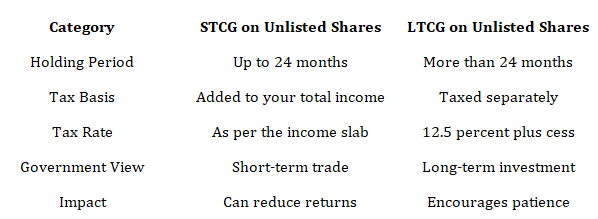
Even a difference of one day beyond 24 months can shift your tax rate drastically, which is why noting the correct purchase and sale dates is essential.
Effect of Recent Tax Changes
Before the updated rules, long-term gains on unlisted shares were taxed at twenty percent with the benefit of indexation. Indexation increased the cost of acquisition to adjust for inflation, reducing the taxable gain.
Now the tax rate is lower at 12.5 percent, but indexation is no longer available.
This change benefits investors with shorter long-term holds and impacts those who prefer to hold for several years.
How to Calculate Capital Gain on Unlisted Shares
The basic formula remains simple:
Sale Price: Cost of Acquisition = Capital Gain
Where it gets more detailed is in determining the actual cost and sale value under different circumstances.
Cost Calculations You Must Get Right
1. FIFO Method (First In, First Out)
If you bought shares in batches and sold a portion later, the earliest purchased shares are considered sold first.
2. Bonus Shares
Bonus shares have a cost of acquisition of zero.
3. Rights Issue
The amount you paid to subscribe becomes the cost.
4. Stock Split Adjustments
Your total cost remains the same, but the cost per share reduces proportionately.
5. ESOP Shares
The Fair Market Value (FMV) on the date of exercise is treated as the acquisition cost.
Special Cases
If shares are received as a gift or inheritance, the original owner’s cost and holding period are passed on to you.
This can help you qualify for LTCG much sooner.
Actual Tax Rates Based on Investor Type 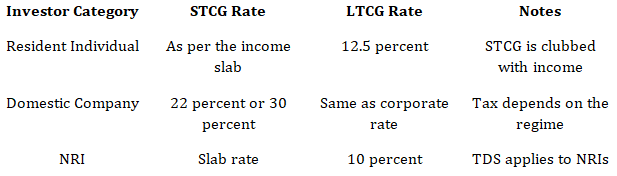
These differences matter when estimating post-tax returns.
Smart Ways to Reduce Your Tax Burden
Tax efficiency is not about shortcuts but about timing and planning.
Here are practical strategies:
1. Time your sale to qualify for LTCG
Crossing the 24-month threshold can cut your tax rate significantly.
2. Split large exits across financial years
This avoids pushing your income into a higher slab.
3. Use tax-loss harvesting
Short-term losses can offset both STCG and LTCG.
Long-term losses can offset long-term gains.
4. Strategic gifting
Gifting shares to a family member in a lower tax slab can reduce overall tax.
However, avoid gifting to spouse or minor children due to clubbing rules.
5. Rebalance periodically
Selling gradually reduces concentration risk and spreads tax liability.
Following these practices ensures more of your profit stays in your portfolio.
Compliance: The Part You Cannot Ignore
Accurate filing is just as important as accurate calculation.
Unlisted share transactions are monitored closely, so your documentation must be complete.
Essential Documents
● Share purchase agreement
● Share transfer form (SH-4)
● Bank payment proofs
● Demat statement
● Valuation certificate (if applicable)
● Sale agreement
● ITR records
Even a small mismatch between the sale price and fair market value can draw scrutiny.
Your capital gain on unlisted shares must be supported by clear paperwork.
Where to Report the Gain
Use Schedule CG when filing your Income Tax Return.
Separate entries are required for STCG and LTCG.
Investors often consult a Chartered Accountant for final verification, especially when dealing with private company valuations.
FAQs
Q1. How are capital gains on unlisted shares calculated?
Capital gain on unlisted shares is calculated by subtracting the cost of acquisition from the sale value. Adjustments apply for FIFO, bonus shares, rights issues, ESOPs, stock splits, or inherited shares.
Q2. What is the tax rate for long-term gains on unlisted shares?
Long-term capital gains on unlisted shares are taxed at 12.5 percent without indexation when held for more than 24 months.
Q3. Are short-term gains on unlisted shares taxed differently?
Yes. Short-term gains (holding period up to 24 months) are added to regular income and taxed as per your income tax slab.
Q4. Is indexation allowed on unlisted shares now?
Indexation was removed under the new tax regime. Earlier, LTCG on unlisted shares was taxed at 20 percent with indexation, but the updated rule is a flat 12.5 percent without indexation.
Q5. How does FIFO apply when selling unlisted shares?
FIFO (First In, First Out) means the earliest purchased shares are considered sold first. This directly affects both gain classification and tax calculation.
Q6. Are valuation certificates necessary?
A valuation certificate is often required when the sale price is significantly different from the fair market value or when selling ESOPs, gifted shares, or transferring shares privately.
Q7. Do NRIs pay a different tax rate on unlisted shares?
Yes. NRIs typically pay 10 percent LTCG plus applicable surcharge and cess. TDS applies at the time of sale.
Q8. Where do I report gains from unlisted shares in my ITR?
Capital gains from unlisted shares must be reported under Schedule CG of your Income Tax Return.
Conclusion
Unlisted shares offer access to promising private companies, but understanding the tax rules is essential for protecting your gains. Everything depends on three pillars: your holding period, your documentation, and your exit strategy.
Knowing how to calculate capital gain on unlisted shares, how the 24-month rule works, and what tax slab applies can save you from costly errors. With proper planning, unlisted shares can be a powerful tool for long-term wealth creation.
If you wish to explore curated unlisted opportunities with transparent information and expert support, platforms like Unlisted Shares India can help you navigate this space with confidence.